Showing posts with label Bernie Sanders. Show all posts

Tuesday, December 29, 2015

For the Benefit of Bernie


Everyone's favorite member of Doc Emmett Brown's Hair Club for Men is back:


And he he's been tweeting:

You have families out there paying 6, 8, 10 percent on student debt but you can refinance your homes at 3 percent. What sense is that?

"What sense is that?" That's a fair question.

For the benefit of Bernie:

col·lat·er·al
kəˈladərəl,kəˈlatrəl/
noun 
1. something pledged as security for repayment of a loan, to be forfeited in the event of a default.
synonyms: security, surety, guarantee, guaranty, insurance, indemnity, indemnification; backing
"she put up her house as collateral for the loan" 
2. something that you don't have with a student loan.


risk 
noun 
1. a possibility of harm or damage against which something is insured. the possibility of financial loss.
"project finance is essentially an exercise in risk management" 
2. a primary component of student loans.


And that's how it makes sense.


--==//oOo\==--


When I first posted that, I was chided for belittling the candidate. And (I was told) Bernie understands the economics of it perfectly well. The problem with the responses of Bernie's supporters is that they appear to be projecting. They assume he understands the economics and they fill in the copious blanks to explain what he really means. This is apparently defined as what they think he means, such as that he's approaching this from the perspective of the people and not the banks. But communication is the candidate's job, and I remain unconvinced that these eloquent expressions of 'real' meaning are contained in Bernie's message.

Perhaps the medium is the problem. After all, you're not going to say much that's profound on Twitter.

Then again... naaaah.... it's still his job to demonstrate his competence. And since I'm an equal-opportunity critic, I find that my guilt remains disengaged. As this is the worst selection of Presidential candidates ever presented, disregarding party entirely, I see no reason to hold back on Bernie's account.

Sanders' tweet borders on pandering in that it ignores the fact that the bankers' perspective is reasonable. "Where's the sense...?" he asks. The sense is obvious, not merely from a profit-making perspective, but from the perspective of keeping the lending institutions solvent so that loans can continue to be made. This is every bit as much in the interest of the public as the banks.


The Real Problem

One thing that would make the loans less risky, and therefore cheaper, is if fewer people defaulted. But often people take on loans to pay for an education that is either not completed (sometimes due to the fact that they're uninterested or unsuited for academics) or because the returns on that investment are non-existent. This last is in direct opposition to what they were promised by people who sell education for a living.

More higher education does not solve either of these problems, and neither does "free" education (in reality, spreading the costs to others). You're still paying for formal education of people who either do not really want it, or will not benefit from it. Taking them out of the system entirely, however, would reduce the economic strain on the system.


A Better Society

One commenter noted that the existing system is not good social policy. "In effect," he says, "you’re purposefully holding the population back from bettering society and themselves." And let's ignore for a moment the hubris required to set one's self up as the arbiter of what makes another human being "better".

If we were to stay on-topic -- Bernie's tweet about interest rates -- and we took "the existing system" to mean the banking system charging more interest for more risk, then this isn't true in the slightest. Increased risk means loss, and in order to be sustainable, this loss must be covered by redistribution among those who did not forfeit. This is exactly what higher interest rates do. You don't get to magically dispel the costs by pretending they don't exist or by hiding them in the bookkeeping. There is no "holding back" involved in making those real costs visible.

If instead we took "the existing system" to mean the concept of you paying for that which is valuable to you, then I don't think that's true, either. Even when we look at it through Socialist eyes and proclaim that "Society" will pay for that which is valuable to the collective, we find that "more higher education" is a terribly unsatisfactory goal. Yet it is the simplistic goal of those socialists who overwhelmingly populate academia.

It is the common trope of those who sell education for a living that you must have their product to be successful, regardless of how you define success. We should approach this claim with the same skepticism with which we approach the claims of anyone who sells anything. While Learning is a wondrous and powerful thing, Education salesmen reflexively conflate "learning" with "college". This is a dangerous fallacy. While there may always be a benefit to the former (and I see no need to argue against it), there is not always a benefit to the latter. There are many paths to learning that don't involve buying their specific product.

But the truth is, if "Society" were to truly operate in its best interests rather than according to the dictates of those who have placed themselves in positions of influence, we would find that less education would be more valuable to the collective. The academicians get it wrong in a big way, and that's why we see stories like this: Why a BA is Now a Ticket to A Job in a Coffee Shop. More and more, college degrees are "required" by lazy HR managers for jobs that actually require no college-level skills. Lower level workers are thereby frozen out of jobs that they are skilled enough to do. These are the people who have placed no stress on the system, have cost society nothing, and who would immediately be productive were they allowed to be. But they are forced out of jobs and onto welfare roles by those who made the self-fulfilling prophecy. College grads who were promised success if they only pursued a diploma are disgruntled to find that this now earns them minimum wage. The Socialists peddling education as a panacea have done little but inflate the cost of higher education while devaluing the diploma and costing society untold billions of dollars in wasted effort and lost opportunity costs.

For decades now, we have let the socialist elite dictate that what makes a person "better" in their eyes should be universally applied to all. Their mistake has raised the cost of education to unsustainable levels. Now these socialists hope to improve the mess they created by decreeing that it should continue at the cost of all. Would it not be better for the collective itself to act to set both the cost and the value of an education rather than depend on the flawed premises of those who peddle the product? There is a mechanism for this, and it's called the Free Market. When it is subverted, as it has been; ruin is the result, as we have experienced.


A Mo' Better Society

Arguably, a better society arises when people are not shamed into pursuing goals which are not their own and when the rest of us bother to appreciate people for more than their social status as measured in years of formal education. Personally, I would find this trend, which began when I was very small, to smack of snobbery were it not now so prevalent due to the result of decades of indoctrination. It is this institutionalized snobbery that prevents us from examining the premise more closely.

Success is personal, and covers a broad spectrum. We don't even have to go to high-profile examples of mega-successful high-school grads and college dropouts like Bill Gates & Paul Allen (Microsoft), Steve Jobs (Apple), Larry Ellison (Oracle), Oprah Winfrey (Oprah), Michael Dell (Dell Computers), Mark Zuckerberg (Facebook), Jack Taylor (Enterprise Rent-a-Car), Dustin Moskovitz (Facebook), Peter Thiel (PayPal), Matt Mullenweg (WordPress), Arash Ferdowsi (DropBox), Ty Warner (Beanie Babies), Aaron Levie (Box), Elizabeth Holmes (Theranos), Stacey Ferreira (MySocialCloud.com), David Karp (Tumblr), Pete Cashmore (Mashable), Daniel Ek (Spotify), Danielle Morrill (Twilio), Jeffrey Kalmikoff (Threadless), Sahil Lavingia (Pinterest), Zach Sims (Codecademy), Ben Milne (Dwolla), David Neeleman (JetBlue Airways), Susan Lyne (AOL), Evan Williams (Blogger), Gabe Newell (Microsoft, Valve), John Mackey (Whole Foods), or Sophia Amoruso (Nasty Gal).

Consider instead the small business entrepreneur who lives just a quarter of a mile from me. He owns car washes, a convenience store, office complexes, strip malls, storage units, a recycling business... all on a high school education. And, he started with nothing but personal drive and a desire to try anything that might make a legitimate profit without regard to whether it was "beneath" him. Or the electrician, apprenticed to his dad, who earns more than a university professor. Or my plumber, who I'm very happy to report makes more than my doctor, since my plumber makes house calls. Or the guy who a couple of decades ago used to fill my furnace's kerosene tank on short notice on cold winter days, who now lives in a three-story mansion. He started out pumping gas. These are not random examples; they're friends and relatives who will recognize themselves here. These folks got the education that they needed to succeed. But "education" doesn't necessarily mean college or university, and it doesn't mean debt. They focused on their interests and put them to work.

The point here is not that you are going to have a wonderful life if you don't go to college; but that you can... just as you can be miserable and broke with a college degree, serving up candied coffee at Starbucks.

When we push people into the system when they are uninterested or unsuited, we run the very real risk of turning successes into failures. Paying for those failures does not prevent them. The comfortably well-off folks above could easily have been dejected college drop-outs if they had bought into the proposition that this expense defined their chances of success.

And the mega-rich who did drop out...? They did so because they were bright enough to reject the proposition outright.


Thursday, July 30, 2015

There's Nothing New Under the Sun... Unless You're Backing Bernie


Inquisitr.com posted an opinion piece July 29 with following title:


As it appears when shared on Facebook, there is beneath that the subtitle:

Bernie Sanders might have a chance if people started believing he has a chance. 

There's a chance if there's a chance!
Can I get a hallelujah?
You don't say! I initially didn't click through, and simply posted back the completely pedestrian (and completely factual) observation that both the headline and the tagline are tautologies (in the logical sense).

Now, what I didn't know at the time, and what makes this interesting now, is that the Facebook friend who posted the link is also the guy who wrote the article. And he doesn't take very well to having his opinion called "unnecessary", particularly when it's unread.

Now, my intent wasn't to personally insult him (remember, I had not read the piece when commenting on the headline), but I did. That's my failing. He's a nice guy, personally, and I like him. The by-line is way at the bottom of the piece, shoved below the prominently illustrated "promoted content" and just above the comments, so I didn't even know he wrote it. But in responding to the article as I would any opinion piece, I came off as something of a dick... which is something I just do. Case in point... I'm not done doing it.

You see, now that I've read it, and I know he wrote it... my observations are the same. I can't honestly change them simply because I stepped on the guy's feelings. And I happened to be right. But here's the stuff he doesn't want to think about. [1]

--==//oOo\\==--

There are several meanings of the word "tautology". One of them is "redundant", but another is "self-defining": that is, true by its very construction, and this is the sense in which the title is tautological. You can put any name whatsoever on either statement, and it is true. Since it is 100% equally true that my neighbor Ned would have a chance at the Presidency if people started believing he has a chance, this observation carries no information.

Now, there are three levels to this piece, the first of which is the title, which by virtue of being tautological, is uninformative. Then there's the body of the piece; which, taken at face value, is slightly less uninformative, but in a different way. The gist of it is this:
  1. Bernie Sanders represents ideas that have broad support among Liberals.
  2. Liberals aren't supporting Bernie Sanders as much as they should because they don't think he can win.
  3. That's a shame.
Maybe so. I pointed out that this is true in every election. There is always some candidate who has really popular ideas and no serious chance of winning. It's terribly uninteresting to note that they could win if only people supported them. That's determined by the definition of an election.

As Ben clarified, "The article is a simple nod to the fact that Bernie is in an unusual position of having support without the faith of his own supporters."

Now, first of all, I think that Bernie has a very good chance at securing his party's nomination. It's far too early to say that he doesn't have the support he needs. Campaigns exist to gather and direct that support. It would be daunting indeed to count the number of candidates who have come from behind to win a nomination or general election.

However, imagining for the sake of argument that Ben is correct about Bernie's support, it is NOT an unusual position to be in. Not at all. Most Libertarians are intimately familiar with the phenomenon, as the vast majority of Americans respond in libertarian fashion when questioned as to their ideas, but still vote for Democrats or Republicans because they psychologically desire to back a winning candidate. Furthermore, while Ben's observation applies to candidates who are "properly labeled", it is a subset of  a problem that can be extended further, to include people who aren't even considered for their ideas due to party branding, such as John B. Anderson in 1980 or Gary Johnson more recently.

Let's provide some examples:
  • Ron Paul has in past elections had broad support among Libertarians, Republicans and Democrats, and many of those who liked his ideas voted for a candidate that "has a chance of winning".
  • Rand Paul has similar buzz around him today.
  • Ditto for Phil Gramm in the 1992 Republican primary. In his case the entirety of one commentator's (Bill Maher's?) rebuttal of Gramm's platform was "Look at him." There can be no bigger indictment of voter superficiality than this... but even this isn't new. Whether a candidate is "pretty" strongly influences the voter's assessment of their electability.

This is called strategic voting, and it's a feature of our electorate system and our psychology. I'll let Wikipedia explain it.

Now, upon first reading Ben's piece, I took it to be a sincere, albeit uninspired, observation of the phenomenon of strategic voting (without being identified as such), and if you read it, you would probably walk away with the same conclusion. So I responded with an identification of the phenomenon, and at least one way in which it can be eliminated:


Instant runoff voting allows voters to vote their conscience, knowing that if they're backing a loser, their vote will fail over to an acceptable alternate candidate. With this system, while many voters will not get the candidate their first preference, they will inevitably get the candidate that represents the largest possible consensus of the electorate. It is truly a solution to the problem of strategic voting. However, as I pointed out to Ben,
Whether you see this phenomenon [strategic voting] as tautological or a travesty often depends on the strength of your own support for the candidate. But quickly you realize that there is an aspect of gameplay to electioneering, and the rules are not structured to ensure the most representative candidate. Rather, there's a strong bias for a certain presentation, party backing, and the perception of electability. And those who actually make the election rules aren't terribly motivated to change them because they're not playing the same game you and I are.
Let's amend that to say they're not playing the same game I am. And we do have a Catch-22 here. In order to change the system in order to encourage voters to vote their actual preference, then you need lawmakers who are inclined to set up election rules that enable it. But all of those in office are beneficiaries of the existing tilted system. So it is definitely an uphill climb, and one in which minority influence will have to be brought to bear to effect change.

Now, keep in mind that IRV is a permanent solution to the problem that is the superficial message of Ben's piece. Now, I would not have expected Ben to come up with that solution. But I most certainly would have expected him to be open to discussion of it in a conversation about the problem. Nevertheless, this was the response:
And I really don't care about your runoff idea. It's not part of the article. I don't care if you think the article shows why it's important, that's not the point. The point is, the grassroots internet movement of this particular candidate (yes similar to Ron Paul, but not entirely) is bigger than it's ever been; but those supporters are still pragmatic. And that's a new thing. Because the internet is new. It is having a larger and larger affect over elections as the years go on, and it's bigger now than ever before.
First of all, to ignore history and declare that pragmatic supporters are a new thing just because we now have an Internet is historically inaccurate. This phenomenon didn't just pop into being when millennials were born. That the Internet has a larger impact due to social media is true, but it ignores that the likely effect is to ameliorate strategic voting because people, having a direct connection to larger groups, will feel more support for their outlying opinions. In other words, he still got it backwards: the evidence supports my contention that it's too early in the race to decry Bernie's imagined lack of support.

But the part that is astonishing here is the evident desire to completely ignore an idea that's not already expressed in the article. Conversation does not exist to re-state and express vapid agreement with whatever was just stated. It exists to carry ideas forward. The opinion expressed in the article occupies "heavily cultivated territory"; I'd like to carry it outside the fence, away from the manicured grounds.

Here a problem is presented; a potential solution is offered; and "I don't care" is the response. And although a pronouncement that something is redundant or uninteresting is clearly a personal opinion, to be taken as such in any conversation; and while saying something is redundant or old news is hell and gone from claiming that no one should talk about it; and although I plainly said "it's new to YOU, so enjoy"; and although we had just spent 70+ messages talking about it, Ben decided to repeatedly attack a straw man of his own construction and design.
And you still haven't explained why you think we shouldn't talk about it, even if it has happened before.
That's because I make it a point never to "explain" statements somebody else made up for me. As I had told Ben earlier, "...my commentary must be unnecessary, because all I have to do is wait for you to make up something on my behalf... which is far more entertaining for me, since it's nothing like I would have said for myself." Sadly, the sarcasm fell into the sar-chasm, and was lost, disturbing a small army of strawmen who sprang up from the abyss.

It was this disproportionate outburst that led me to the third level to the piece, which I had initially ignored, but which underlies everything else. It was disguised as an analysis with a headline so boring as to put me off from reading it until cajoled into it. And it's possible that Ben's not even consciously aware of this level. Certainly my conversation with him leads me to entertain that possibility. The real underlying message, which having been ignored, caused so much pain, is this:

"Vote for Bernie".

*sigh*

Election reform isn't interesting and doesn't address the 'problem' because the 'problem' is that people don't plan to vote for Bernie. So the "real" solution is to vote for Bernie.

That's even less interesting than the superficial message. It almost makes me glad I hurt his feelings. Told you I was a dick.


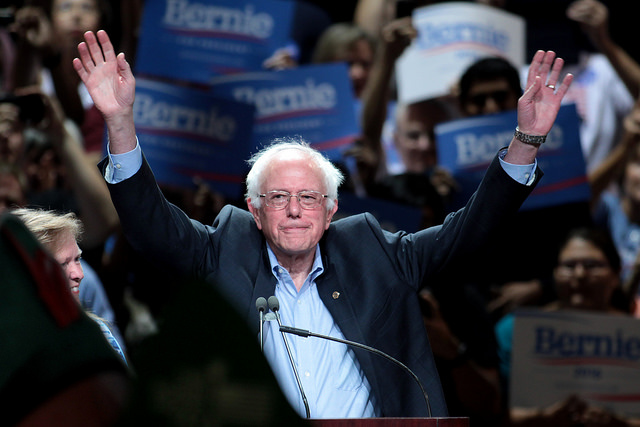
Photo of Bernie Sanders by Gage Skidmore via Flickr. Used with permission under a Creative Commons Attribution Share-alike license. 

[1] Portions of the conversation are reproduced here by virtue of the fact that the conversation in which they appeared was shared with the Public.

.