Showing posts with label Instant Runoff Voting. Show all posts

Saturday, February 20, 2016

Don't Vote. It's Your Right.

It's Primary election season, and in particular it's election day in South Carolina if you're voting in the Republican Primary.

South Carolina's primary is interesting in that it is an open primary. This is the day when Democrats turn out in force to vote for the Republican candidate that they think will perform the worst against a Democrat in a general election.

Or perhaps it's a good time to just jump the fence. Trump's campaign is counting on it. He knows that up to 20% of Democrats can be made to defect. Those include Democrats that can't endorse Clinton's baggage or Sanders' socialism. He has no intention of winning with Republican votes alone. And that's OK... you expect to appeal to more than just your party in the general election.

Photo by Stacy Mae via Facebook
Where Trump differs is that he's actively targeting Democrats in the Republican primary. Click to "embiggen" the photo above and note the "Open Primary" on the campaign sign.

We might see a little more of that next week during the Democratic primary, which is also open. Bernie Sanders is actively courting Rand Paul voters, and that's perfectly fine, too, even though I think Sanders is mistaken in the belief that their support of legal marijuana is based on a desire for marijuana vs. a desire for Liberty. (In fact if you talk to them, you'll find out that they have very little interest in "legalizing" marijuana. They want to repeal the laws that criminalize it in the first place. It's not really a subtle difference.)

--==//oOo\\==--

And this brings up a point... it's a common tactic during elections to drum up votes by shaming people into voting. They tell you how much it's your duty to vote, that "you can't complain" if you don't vote, etc.
99.44% of the time they have no interest in you going to just cast a vote. Rather, they want you to cast a vote in their direction. 
If that doesn't describe you... then you're part of the 0.56%. Congrats.
That's really visible in the case of an open primary where people can "tactically vote" for the other side. If they were voting honestly and fairly, the "correct" thing to do in the case of another party's primary would be to not vote at all. To abstain, and then vote in their own primary.

But that's not the only time when it makes sense not to vote.

Look... you're not doing anyone any favors if you're voting just to vote. The American electoral system is based on the idea that people will vote in their interest... and it being a republic, that they will vote for people to represent those interests. Lacking that, they should stand for election and represent their own interests. This has long since been perverted into a party system, and for many reasons (for instance, lack of money or political talent) an individual may not be able to represent their own interests politically. The system that we have actively discourages participation by any but Republicans and Democrats, neither of which may represent you at all. It's not to your advantage to compromise your interests just to go through the motions of pushing a button or pulling a lever when you're told.

Here are completely valid reasons not to vote:
  1. There is no candidate with whom you agree. For instance, a die-hard Rand Paul fan might find himself without a voice now that his candidate has dropped out of the race. In this primary election he may be completely without representation, and thus may choose to abstain. This is reasonable.
  2. You may be ignorant of the candidates' views. Sure, you should have done your homework long before election day, but you didn't and it's water under the bridge. The fact remains that you can't make an informed decision, and your "duty" as a voter is not to "cast a vote"... it's to cast an informed one. You're not going to satisfy that duty by cramming on election day. Rather than let the alphabet, or pure chance decide for you, you abstain. This allows the decision to be made by informed minds. This is reasonable. 
  3. Same as 2, but you're being guilt-tripped into it by people who are trying to steal your voice. They want you cast a proxy vote for them. In other words, they want to cheat. Typically they'll send a bus 'round to take you to the polls and "educate" you as to who to vote for on the way. They don't see it as cheating, because they're all wrapped up in the larger cause that they're pursuing. It's vitally important to them that "Candidate Jones" gets elected, and they don't even think about whether you vote for a candidate of your free, unfettered, and informed choice. Should you push back because you're feeling manipulated or imposed upon, then it's because you are. This is reasonable.
Basically, if you don't want to vote, it is your right to abstain. You no more have to give your reasons than they have to tell you who they voted for.

--==//oOo\\==--

So what about the people who tell you that you've forfeited your right to complain if you don't vote?

Well basically, they're full of shit, and I won't tell you that without explanation:
  1. Your First Amendment right to free speech and more especially to petition the government for the redress of grievances is not constrained by whether or not you cast a vote. Ever. It is an unalienable right which may not be abridged. So "Mr. You-can't-complain" is simply full of shit, as he's suggesting an unconstitutional penalty for your choice to abstain, and therefore has neither the business nor the wisdom to coach you on election politics. This trumps any other excuse he may throw at you, without any exception whatsoever.
That's it. A list of one.

I actually had a long list of reasons; but basically, they're unnecessary.
  • the fact that you had no viable candidate for whom to vote; 
  • the fact that you may have already participated in the electoral system by financially or otherwise supporting a candidate who didn't survive to be on your ballot;
  • the fact that the "informed voters" chose so poorly in not only the general election, but in a succession of primary elections leading up to yours that you were faced with this non-choice; 
  • the fact that we have a plurality election system that allows a candidate to "win" an election despite having two thirds of the vote cast in favor of anyone but that candidate (instead of a vastly more reasonable instant run-off system)
... all of these are valid reasons to complain, whether you voted or not. But be assured that they are all eclipsed by the fact that free speech is your right.

If anything, the person who does vote has no business complaining. He's the one who willingly took part in a system that by many objective standards is completely broken. If he casts a vote and the majority wins, whether he's a part of that majority or not, then he has agreed to take part in and accept the results of this broken system.

So he's the one who should STFU and stop bitching.

--==//oOo\\==--

If you really want to see less post-election complaining, then don't guilt-trip citizens out of their First Amendment right to air grievances. Rather, you should advocate a switch to a system that's not broken.


You might not get your favorite candidate, but under this system the voters will always elect a candidate that the maximum number of citizens can best live with.

And by the way... you'll note that this is not the kind of positive change that can ever be effected by telling they have no say because they didn't endorse the system they want to replace.


UPDATE:

Someone already disagrees... can't say I'm surprised. The gist of it:
If you're not informed, then its your fault. If your favorite candidate isn't there, then vote against your least favorite or spoil your vote. But not voting at all makes you a "lazy shit".
In response, I should mention this... if you're abstaining just because you're lazy, then I don't like that at all. But your rights are not determined by what I like.

It's still your right to abstain, and you still have the right to complain. Keep in mind that I'm primarily blogging against telling people they can't complain, which is just plain false. I'm not advocating not voting... but I don't endorse elections that are decided by uninformed voters. So I encourage you to inform yourself or don't vote. If you're ignorant, and you want to stay home, do it. It's the best thing you can do. Furthermore, I don't encourage people to be forced to choose between a giant douche and a turd sandwich. That's a false dichotomy. You have other choices, one of which is to abstain. Sure, you could write in "Porky Pig", but that's a different message than "I'm not going to participate in this process". You have that Constitutional right to abstain whether some bully wants you to exercise it or not.

But if someone abstains because it's their choice not to vote... because their interests are not represented, or are best expressed by actively abstaining... that's the complete opposite of being a "lazy shit", and you would do well to recognize the difference.

Thursday, July 30, 2015

There's Nothing New Under the Sun... Unless You're Backing Bernie


Inquisitr.com posted an opinion piece July 29 with following title:


As it appears when shared on Facebook, there is beneath that the subtitle:

Bernie Sanders might have a chance if people started believing he has a chance. 

There's a chance if there's a chance!
Can I get a hallelujah?
You don't say! I initially didn't click through, and simply posted back the completely pedestrian (and completely factual) observation that both the headline and the tagline are tautologies (in the logical sense).

Now, what I didn't know at the time, and what makes this interesting now, is that the Facebook friend who posted the link is also the guy who wrote the article. And he doesn't take very well to having his opinion called "unnecessary", particularly when it's unread.

Now, my intent wasn't to personally insult him (remember, I had not read the piece when commenting on the headline), but I did. That's my failing. He's a nice guy, personally, and I like him. The by-line is way at the bottom of the piece, shoved below the prominently illustrated "promoted content" and just above the comments, so I didn't even know he wrote it. But in responding to the article as I would any opinion piece, I came off as something of a dick... which is something I just do. Case in point... I'm not done doing it.

You see, now that I've read it, and I know he wrote it... my observations are the same. I can't honestly change them simply because I stepped on the guy's feelings. And I happened to be right. But here's the stuff he doesn't want to think about. [1]

--==//oOo\\==--

There are several meanings of the word "tautology". One of them is "redundant", but another is "self-defining": that is, true by its very construction, and this is the sense in which the title is tautological. You can put any name whatsoever on either statement, and it is true. Since it is 100% equally true that my neighbor Ned would have a chance at the Presidency if people started believing he has a chance, this observation carries no information.

Now, there are three levels to this piece, the first of which is the title, which by virtue of being tautological, is uninformative. Then there's the body of the piece; which, taken at face value, is slightly less uninformative, but in a different way. The gist of it is this:
  1. Bernie Sanders represents ideas that have broad support among Liberals.
  2. Liberals aren't supporting Bernie Sanders as much as they should because they don't think he can win.
  3. That's a shame.
Maybe so. I pointed out that this is true in every election. There is always some candidate who has really popular ideas and no serious chance of winning. It's terribly uninteresting to note that they could win if only people supported them. That's determined by the definition of an election.

As Ben clarified, "The article is a simple nod to the fact that Bernie is in an unusual position of having support without the faith of his own supporters."

Now, first of all, I think that Bernie has a very good chance at securing his party's nomination. It's far too early to say that he doesn't have the support he needs. Campaigns exist to gather and direct that support. It would be daunting indeed to count the number of candidates who have come from behind to win a nomination or general election.

However, imagining for the sake of argument that Ben is correct about Bernie's support, it is NOT an unusual position to be in. Not at all. Most Libertarians are intimately familiar with the phenomenon, as the vast majority of Americans respond in libertarian fashion when questioned as to their ideas, but still vote for Democrats or Republicans because they psychologically desire to back a winning candidate. Furthermore, while Ben's observation applies to candidates who are "properly labeled", it is a subset of  a problem that can be extended further, to include people who aren't even considered for their ideas due to party branding, such as John B. Anderson in 1980 or Gary Johnson more recently.

Let's provide some examples:
  • Ron Paul has in past elections had broad support among Libertarians, Republicans and Democrats, and many of those who liked his ideas voted for a candidate that "has a chance of winning".
  • Rand Paul has similar buzz around him today.
  • Ditto for Phil Gramm in the 1992 Republican primary. In his case the entirety of one commentator's (Bill Maher's?) rebuttal of Gramm's platform was "Look at him." There can be no bigger indictment of voter superficiality than this... but even this isn't new. Whether a candidate is "pretty" strongly influences the voter's assessment of their electability.

This is called strategic voting, and it's a feature of our electorate system and our psychology. I'll let Wikipedia explain it.

Now, upon first reading Ben's piece, I took it to be a sincere, albeit uninspired, observation of the phenomenon of strategic voting (without being identified as such), and if you read it, you would probably walk away with the same conclusion. So I responded with an identification of the phenomenon, and at least one way in which it can be eliminated:


Instant runoff voting allows voters to vote their conscience, knowing that if they're backing a loser, their vote will fail over to an acceptable alternate candidate. With this system, while many voters will not get the candidate their first preference, they will inevitably get the candidate that represents the largest possible consensus of the electorate. It is truly a solution to the problem of strategic voting. However, as I pointed out to Ben,
Whether you see this phenomenon [strategic voting] as tautological or a travesty often depends on the strength of your own support for the candidate. But quickly you realize that there is an aspect of gameplay to electioneering, and the rules are not structured to ensure the most representative candidate. Rather, there's a strong bias for a certain presentation, party backing, and the perception of electability. And those who actually make the election rules aren't terribly motivated to change them because they're not playing the same game you and I are.
Let's amend that to say they're not playing the same game I am. And we do have a Catch-22 here. In order to change the system in order to encourage voters to vote their actual preference, then you need lawmakers who are inclined to set up election rules that enable it. But all of those in office are beneficiaries of the existing tilted system. So it is definitely an uphill climb, and one in which minority influence will have to be brought to bear to effect change.

Now, keep in mind that IRV is a permanent solution to the problem that is the superficial message of Ben's piece. Now, I would not have expected Ben to come up with that solution. But I most certainly would have expected him to be open to discussion of it in a conversation about the problem. Nevertheless, this was the response:
And I really don't care about your runoff idea. It's not part of the article. I don't care if you think the article shows why it's important, that's not the point. The point is, the grassroots internet movement of this particular candidate (yes similar to Ron Paul, but not entirely) is bigger than it's ever been; but those supporters are still pragmatic. And that's a new thing. Because the internet is new. It is having a larger and larger affect over elections as the years go on, and it's bigger now than ever before.
First of all, to ignore history and declare that pragmatic supporters are a new thing just because we now have an Internet is historically inaccurate. This phenomenon didn't just pop into being when millennials were born. That the Internet has a larger impact due to social media is true, but it ignores that the likely effect is to ameliorate strategic voting because people, having a direct connection to larger groups, will feel more support for their outlying opinions. In other words, he still got it backwards: the evidence supports my contention that it's too early in the race to decry Bernie's imagined lack of support.

But the part that is astonishing here is the evident desire to completely ignore an idea that's not already expressed in the article. Conversation does not exist to re-state and express vapid agreement with whatever was just stated. It exists to carry ideas forward. The opinion expressed in the article occupies "heavily cultivated territory"; I'd like to carry it outside the fence, away from the manicured grounds.

Here a problem is presented; a potential solution is offered; and "I don't care" is the response. And although a pronouncement that something is redundant or uninteresting is clearly a personal opinion, to be taken as such in any conversation; and while saying something is redundant or old news is hell and gone from claiming that no one should talk about it; and although I plainly said "it's new to YOU, so enjoy"; and although we had just spent 70+ messages talking about it, Ben decided to repeatedly attack a straw man of his own construction and design.
And you still haven't explained why you think we shouldn't talk about it, even if it has happened before.
That's because I make it a point never to "explain" statements somebody else made up for me. As I had told Ben earlier, "...my commentary must be unnecessary, because all I have to do is wait for you to make up something on my behalf... which is far more entertaining for me, since it's nothing like I would have said for myself." Sadly, the sarcasm fell into the sar-chasm, and was lost, disturbing a small army of strawmen who sprang up from the abyss.

It was this disproportionate outburst that led me to the third level to the piece, which I had initially ignored, but which underlies everything else. It was disguised as an analysis with a headline so boring as to put me off from reading it until cajoled into it. And it's possible that Ben's not even consciously aware of this level. Certainly my conversation with him leads me to entertain that possibility. The real underlying message, which having been ignored, caused so much pain, is this:

"Vote for Bernie".

*sigh*

Election reform isn't interesting and doesn't address the 'problem' because the 'problem' is that people don't plan to vote for Bernie. So the "real" solution is to vote for Bernie.

That's even less interesting than the superficial message. It almost makes me glad I hurt his feelings. Told you I was a dick.


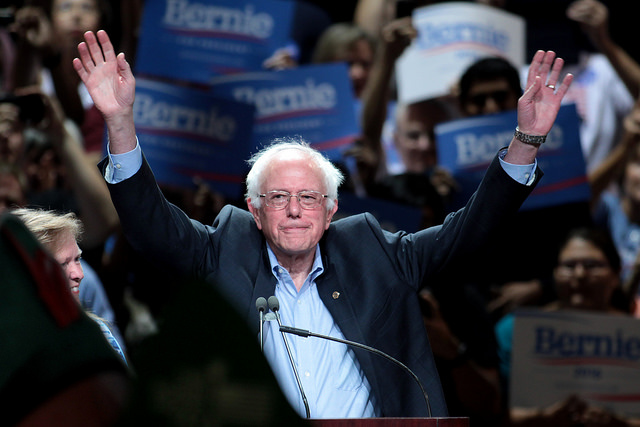
Photo of Bernie Sanders by Gage Skidmore via Flickr. Used with permission under a Creative Commons Attribution Share-alike license. 

[1] Portions of the conversation are reproduced here by virtue of the fact that the conversation in which they appeared was shared with the Public.

.