Showing posts with label Dirty Laundry. Show all posts

Thursday, July 30, 2015

There's Nothing New Under the Sun... Unless You're Backing Bernie


Inquisitr.com posted an opinion piece July 29 with following title:


As it appears when shared on Facebook, there is beneath that the subtitle:

Bernie Sanders might have a chance if people started believing he has a chance. 
There's a chance if there's a chance!
Can I get a hallelujah?
You don't say! I initially didn't click through, and simply posted back the completely pedestrian (and completely factual) observation that both the headline and the tagline are tautologies (in the logical sense).

Now, what I didn't know at the time, and what makes this interesting now, is that the Facebook friend who posted the link is also the guy who wrote the article. And he doesn't take very well to having his opinion called "unnecessary", particularly when it's unread.

Now, my intent wasn't to personally insult him (remember, I had not read the piece when commenting on the headline), but I did. That's my failing. He's a nice guy, personally, and I like him. The by-line is way at the bottom of the piece, shoved below the prominently illustrated "promoted content" and just above the comments, so I didn't even know he wrote it. But in responding to the article as I would any opinion piece, I came off as something of a dick... which is something I just do. Case in point... I'm not done doing it.

You see, now that I've read it, and I know he wrote it... my observations are the same. I can't honestly change them simply because I stepped on the guy's feelings. And I happened to be right. But here's the stuff he doesn't want to think about. [1]

--==//oOo\\==--

There are several meanings of the word "tautology". One of them is "redundant", but another is "self-defining": that is, true by its very construction, and this is the sense in which the title is tautological. You can put any name whatsoever on either statement, and it is true. Since it is 100% equally true that my neighbor Ned would have a chance at the Presidency if people started believing he has a chance, this observation carries no information.

Now, there are three levels to this piece, the first of which is the title, which by virtue of being tautological, is uninformative. Then there's the body of the piece; which, taken at face value, is slightly less uninformative, but in a different way. The gist of it is this:
  1. Bernie Sanders represents ideas that have broad support among Liberals.
  2. Liberals aren't supporting Bernie Sanders as much as they should because they don't think he can win.
  3. That's a shame.
Maybe so. I pointed out that this is true in every election. There is always some candidate who has really popular ideas and no serious chance of winning. It's terribly uninteresting to note that they could win if only people supported them. That's determined by the definition of an election.

As Ben clarified, "The article is a simple nod to the fact that Bernie is in an unusual position of having support without the faith of his own supporters."

Now, first of all, I think that Bernie has a very good chance at securing his party's nomination. It's far too early to say that he doesn't have the support he needs. Campaigns exist to gather and direct that support. It would be daunting indeed to count the number of candidates who have come from behind to win a nomination or general election.

However, imagining for the sake of argument that Ben is correct about Bernie's support, it is NOT an unusual position to be in. Not at all. Most Libertarians are intimately familiar with the phenomenon, as the vast majority of Americans respond in libertarian fashion when questioned as to their ideas, but still vote for Democrats or Republicans because they psychologically desire to back a winning candidate. Furthermore, while Ben's observation applies to candidates who are "properly labeled", it is a subset of  a problem that can be extended further, to include people who aren't even considered for their ideas due to party branding, such as John B. Anderson in 1980 or Gary Johnson more recently.

Let's provide some examples:
  • Ron Paul has in past elections had broad support among Libertarians, Republicans and Democrats, and many of those who liked his ideas voted for a candidate that "has a chance of winning".
  • Rand Paul has similar buzz around him today.
  • Ditto for Phil Gramm in the 1992 Republican primary. In his case the entirety of one commentator's (Bill Maher's?) rebuttal of Gramm's platform was "Look at him." There can be no bigger indictment of voter superficiality than this... but even this isn't new. Whether a candidate is "pretty" strongly influences the voter's assessment of their electability.

This is called strategic voting, and it's a feature of our electorate system and our psychology. I'll let Wikipedia explain it.

Now, upon first reading Ben's piece, I took it to be a sincere, albeit uninspired, observation of the phenomenon of strategic voting (without being identified as such), and if you read it, you would probably walk away with the same conclusion. So I responded with an identification of the phenomenon, and at least one way in which it can be eliminated:


Instant runoff voting allows voters to vote their conscience, knowing that if they're backing a loser, their vote will fail over to an acceptable alternate candidate. With this system, while many voters will not get the candidate their first preference, they will inevitably get the candidate that represents the largest possible consensus of the electorate. It is truly a solution to the problem of strategic voting. However, as I pointed out to Ben,
Whether you see this phenomenon [strategic voting] as tautological or a travesty often depends on the strength of your own support for the candidate. But quickly you realize that there is an aspect of gameplay to electioneering, and the rules are not structured to ensure the most representative candidate. Rather, there's a strong bias for a certain presentation, party backing, and the perception of electability. And those who actually make the election rules aren't terribly motivated to change them because they're not playing the same game you and I are.
Let's amend that to say they're not playing the same game I am. And we do have a Catch-22 here. In order to change the system in order to encourage voters to vote their actual preference, then you need lawmakers who are inclined to set up election rules that enable it. But all of those in office are beneficiaries of the existing tilted system. So it is definitely an uphill climb, and one in which minority influence will have to be brought to bear to effect change.

Now, keep in mind that IRV is a permanent solution to the problem that is the superficial message of Ben's piece. Now, I would not have expected Ben to come up with that solution. But I most certainly would have expected him to be open to discussion of it in a conversation about the problem. Nevertheless, this was the response:
And I really don't care about your runoff idea. It's not part of the article. I don't care if you think the article shows why it's important, that's not the point. The point is, the grassroots internet movement of this particular candidate (yes similar to Ron Paul, but not entirely) is bigger than it's ever been; but those supporters are still pragmatic. And that's a new thing. Because the internet is new. It is having a larger and larger affect over elections as the years go on, and it's bigger now than ever before.
First of all, to ignore history and declare that pragmatic supporters are a new thing just because we now have an Internet is historically inaccurate. This phenomenon didn't just pop into being when millennials were born. That the Internet has a larger impact due to social media is true, but it ignores that the likely effect is to ameliorate strategic voting because people, having a direct connection to larger groups, will feel more support for their outlying opinions. In other words, he still got it backwards: the evidence supports my contention that it's too early in the race to decry Bernie's imagined lack of support.

But the part that is astonishing here is the evident desire to completely ignore an idea that's not already expressed in the article. Conversation does not exist to re-state and express vapid agreement with whatever was just stated. It exists to carry ideas forward. The opinion expressed in the article occupies "heavily cultivated territory"; I'd like to carry it outside the fence, away from the manicured grounds.

Here a problem is presented; a potential solution is offered; and "I don't care" is the response. And although a pronouncement that something is redundant or uninteresting is clearly a personal opinion, to be taken as such in any conversation; and while saying something is redundant or old news is hell and gone from claiming that no one should talk about it; and although I plainly said "it's new to YOU, so enjoy"; and although we had just spent 70+ messages talking about it, Ben decided to repeatedly attack a straw man of his own construction and design.
And you still haven't explained why you think we shouldn't talk about it, even if it has happened before.
That's because I make it a point never to "explain" statements somebody else made up for me. As I had told Ben earlier, "...my commentary must be unnecessary, because all I have to do is wait for you to make up something on my behalf... which is far more entertaining for me, since it's nothing like I would have said for myself." Sadly, the sarcasm fell into the sar-chasm, and was lost, disturbing a small army of strawmen who sprang up from the abyss.

It was this disproportionate outburst that led me to the third level to the piece, which I had initially ignored, but which underlies everything else. It was disguised as an analysis with a headline so boring as to put me off from reading it until cajoled into it. And it's possible that Ben's not even consciously aware of this level. Certainly my conversation with him leads me to entertain that possibility. The real underlying message, which having been ignored, caused so much pain, is this:

"Vote for Bernie".

*sigh*

Election reform isn't interesting and doesn't address the 'problem' because the 'problem' is that people don't plan to vote for Bernie. So the "real" solution is to vote for Bernie.

That's even less interesting than the superficial message. It almost makes me glad I hurt his feelings. Told you I was a dick.


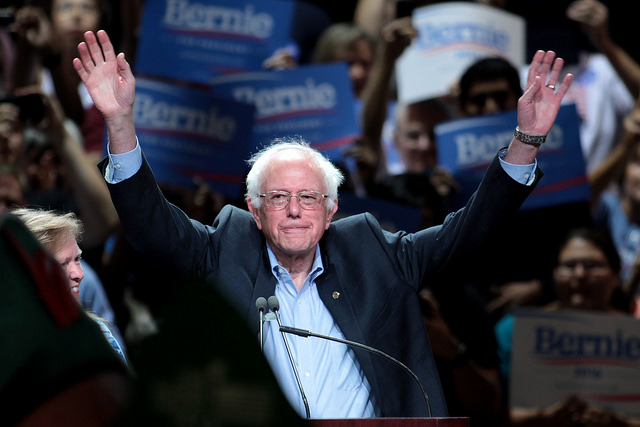
Photo of Bernie Sanders by Gage Skidmore via Flickr. Used with permission under a Creative Commons Attribution Share-alike license. 

[1] Portions of the conversation are reproduced here by virtue of the fact that the conversation in which they appeared was shared with the Public.

.

Wednesday, July 15, 2015

Smell the Irony, Redux

Without these, what will we use to line our birdcages?!?
I don't like to let an opportunity go missed. I received a comment for my last post, (Smell the Irony) that was delicious. However, apparently the commenter thought better of it, because when I went to approve it, I found that it had apparently been deleted. Since it *was* deleted, I'll withhold the name of the commenter, but the comment itself was too pithy not to respond. Yes, I realize that, since it was withdrawn by the commenter, even he must have found something wrong with it, which makes it a bit of a straw man; but honestly I don't care.  As straw men go, this one is a living, breathing example of what someone in the journalism business thinks. I'm not going to reproduce it in its entirety (it was longer than my original piece; hence this is also), but you'll get the gist well enough from context.

The commenter (to whom I will hereafter refer with the Slashdot convention of "Anonymous Coward", or "A.C.") lead with, "Maybe you should learn a bit more about the journalism business before you slam them for wanting to make a living doing the job. " And took me to task from there. A.C. works in a support role in the field of Journalism.


--==//ooOoo\\==--


Full disclosure on my part for your benefit, A.C. ... I did learn a bit more about the Journalism business before I opined. I was raised in a newspaper household from the time I was 6 years old until I was 21. My stepfather was the foreman of the engraving department at The State/Columbia Record newspapers. We spent every summer vacation at editorial cartoonist Jak Smyrl's beach house at Holden Beach. It was my dream to become a reporter, and I worked hard for it. I was editor-in-chief of my high school paper, steeped myself in All Things Journalism, and became a Journalism major in college.

I decided to switch careers once I discovered that I was in a distinct minority when it comes to valuing facts over spin in news reporting. One day I had a professor ask us why we wanted to become reporters. In a classroom of about 30 people I was the only one who didn't want to shape opinion and change the world. My 'naive' goal was to report the facts so people could make informed decisions for themselves. Of course, this wasn't the only factor in my decision, but this one poll pretty well perfectly summarized the problem for me. We had gone from Edward R. Murrow and Walter Cronkite to newspeak, and only a few years shy of the actual year 1984. I left that very classroom that very day, walked about two blocks to a military recruiter's office, and joined the United States Air Force so I could continue to eat while I reassessed my priorities. The one thing I knew was that I didn't want to work with those asses for the rest of my life.

On the op/ed page, opinions quite rightly rule; but you will rarely, if ever, find neutral reporting in a US newspaper. When you do learn about the journalism business, you can't help but know that the facts presented (or withheld), the tone of the reporting, the lede, the headline... everything is colored by the editorial position that the paper would like to take, and that color is increasingly yellow. It's not terribly noticeable if your opinion and the paper's happen to align. But if you are truly of independent thought, then it is glaringly obvious.

It is true that newspapers are under stress. They are under stress because many of them don't understand the new economic ecology. There was a day when almost the entirety of the news was controlled by the local paper and three broadcast networks. Those decision-makers in the industry who operated in a climate with severely limited competition (and thus continue to overestimate their own importance in a new climate where competition is fierce) are exactly those to whom I refer when I say "dinosaurs of the Press".


Mo' Freedom, Mo' Choice

You speak derisively of people who expect music and movies to be free; but this derision is based on a fundamental misunderstanding of their expectation. Specifically, it's not just the misunderstanding of freedom vs. price: it's a misunderstanding of the way that the economy has always worked.

For instance, music sales have always been driven by people who have heard songs "for free". To pretend it is otherwise is pure historical revisionism. Even prior to "free" radio play, songs were played "for free" by Tin Pan Alley piano players to entice people to buy the sheet music. Now, new channels now exist for monetization. Just because you prefer one over another doesn't mean I have to prefer the same one. The market will determine the winner, and if you bet wrong, then it's not my job to mourn your passing.

Within those new channels, people are more than willing to pay artists, even as they are less than willing to support the system that continues to exploit them. For instance, I pay in advance for indie movies (like this one!) on Kickstarter because I don't expect them for free. Likewise, I preferentially purchase music from indie artists whose work I discovered through free distribution. I've funded more than a few first albums on Kickstarter as well. Furthermore, I provide payments through Patreon to artists directly in order to encourage them to produce more.

So don't bitch about the economic climate. That's what dinosaurs do when they don't want to adapt.


--==//ooOoo\\==--


Speaking of that climate, actual newspaper sales are going down. Ad revenue is going down. Duh. Advertisers are still paying for eyeballs, and their customers aren't reading print anymore. This was obvious and foreseeable twenty years ago. And it's true that website traffic is not anywhere near what the original newsprint revenue was, just as it's true that production costs for a website are a mere fraction of the production costs of an ink-and-paper issue. Revenue is not profit, and focus on revenue detracts from an informed discussion of the actual viability of news sources.


Business as usual (to those who weren't asleep)

You berate others for scraping and stealing stories without revenue for the generators, ignoring the fact that the same has always been true of print publications. When someone breaks a story, everyone else will inevitably report on it. You complain as if this is something new rather than the way it has always been, even though you damned well know that to be the case. The only difference here is in the scope of it. Scraping and stealing in toto is certainly actionable plagiarism; however, as you very well know, exceptions have always existed under Title 17 for editorial comment, education, and parody... Fair Use. And attribution isn't plagiarism. When a competitor reports on a story and credits The Times for the information, then it not only increases the reputation of The Times, but readers will want a copy of the first-hand report. There are financial benefits to attribution. Perhaps you don't believe that, or think they're over-rated. Fine. If you want to throw out the baby with the bathwater, then paywall your sites and get them off of the bloody Internet and off of the search engines.

Tell us whether your revenue goes up... or tanks. It doesn't matter which. The point here is you get to make your choices about your business strategy. If you don't like the way the Internet works, don't stand there and bitch about it. Do it another way.

Journalism is most certainly about “prestige and royalties for re-prints and moneymoneymoney.” Yet you say it's not, immediately after having raked others over the coals that very thing. Prestige is what preferentially drives people to your "trusted" publication rather than others and keeps your circulation high. Re-print rights are exactly what's discussed when you're complaining about "scraping and stealing". Profitability keeps you in business. And you have the chutzpah to claim that *I* don't know what I'm talking about. Pot, meet kettle.

Yes, it takes time and effort and cost to put together a story. It's up to you to monetize it, in a way that works in the economy in which you find yourselves. No one is here to change the economy on your behalf simply because you find it to be inconvenient or difficult. And nobody is here to legislate the inclusion of a buggy whip with each motorcar, just because you happen to make the whips.

And none of the economic factors have anything whatsoever to do with the central fact of my commentary. We are still talking about government-held information that has no business being withheld from the public. Our elected officials are not your errand boys and bouncers, keeping the public away from information while providing it to you alone. The Freedom of Information Act (FOIA) was signed into law in 1966. Nineteen hundred and sixty-bloody-six. There was no Internet. It was expensive and time-consuming to copy massive amounts of information, so it was reasonable to require a fee and to limit the dissemination to those who asked for it. But 1966 is half a century gone, and you are basing your complaints on a model of investigation and economics that's just as obsolete.

Talk to the hand. I have no sympathy for you.

Frankly, it takes astonishing hubris to imply that the public needs your "rational and reasonable narrative". The first implication is that it is "rational and reasonable", which is debatable. The second implication is that it wouldn't be there without you. The FOIA wasn't put there for you, it was put there for the public. You just happen to be included in that group, and you happen to have benefited for a time from archaic technological limitations. But the FOIA is bigger than you, and facts alone inform the public just fine.

You ask who will make those requests if it isn't for you. Who do you think? Watchdog groups, individual citizens, attorneys for class-action litigation, independent journalists and news organizations that have actually figured out the economy... the list is pretty much endless. Just because you haven't figure it out doesn't mean everybody else is clueless. Ideally at some point we will no longer need the requests at all because the information will be directly searchable, but I am quite serious when I say that incremental improvement is still improvement, and I'll take it.


--==//ooOoo\\==--


Finally, you ask whether I give my time and expertise away. Yes, I do, often.

I've not only done it with the little bit of music I create, providing it not only via the web, but also for the occasional community play; I've done it with a number of open source projects that anybody anywhere could duplicate without a contract to guarantee my payment for time and effort.

Here's how it works: I create what I want. It not only acts as something of a portfolio; but also provides me with tailored software that would otherwise be expensive, or often simply wouldn't exist at all. Thus, the effort is of value to me personally even if no one else pays me a dime. I do it when I feel like it, and I provide it for free, because I see no reason not to. Just because I can horde my skills doesn't mean I have to. But it is my work, so I leverage existing copyright law to license my work under Creative Commons so that you can't come along and sequester what I have freely chosen to share them with others.

Now, even though I don't generally advertise it any more, occasionally other people have stumbled upon and used some of my software and asked me if it can be modified for some feature of their choosing. I tell them it certainly can... they have the source code. But I'm nobody's slave. I do what I want for free, but I'll happily do what they want for a fee. And although they could make the change themselves, they have freely chosen to pay for my time and expertise to make the changes for them[1].

It's not just me. Thousands of developers do this, on GitHub, on SourceForge, on OpenNTF and other sites. You're in a tech supporting role, Anonymous. Surely you know that people actually get paid for this stuff. But like the news, the real currency that drives the monetization of skills is reputation.

It's hilarious to me that you would attempt to use my everyday reality as an illustration of your problem, suggesting that if only I understood it, I'd have a better idea of what you're going through.

Smell the fucking irony. 


Image via Flicker by Jon S.  Creative Commons, bay-bee!

[1] But here's what I don't do... I don't put thoughts in other people's heads and then pretend as though I have the right or might to claim exclusive ownership of the thoughts now housed in their brains. What you think of as "intellectual property" is the artificial privilege of limited-time monopoly granted to you by the People through the agency of the State in order to encourage productivity. That is the complete and total extent of its resemblance to "property". Read the Constitution. The delusional mindset that insists on the "right" of "intellectual property" is distilled idiocy. You own your thoughts; but you don't own mine. So if you want exclusive "ownership" of an idea, then the very best way secure it is to keep your mouth shut. Seriously. Otherwise you can expect no more "ownership" than the strict letter of the law allows.