Saturday, May 09, 2009

REVIEW: Star Trek is a Winner

Warning: if you don't like spoilers, don't read this. True Trek fans don't mind the spoilers.

I'm a Star Trek fan from Day One. I vividly remember watching the Man Trap episode on Sep 8, 1966. I was only 4 years old at the time, and it was the most terrifying thing I'd seen up to that date. Today I know enough not to confuse it with hard science fiction, but I'm willing to set aside physics for Star Trek. As a hard-core fan, I'm of the opinion that you do not under any circumstances EVER mess with the original characters.

This is one of the reasons I love Star Trek Phase II, where James Cawley and a host of volunteers have not only accurately mimicked the look and feel of the original series, but have managed to bridge the gap between it and the original cast movies. So it was with not a little trepidation that I heard that J.J. Abrams was going to "reboot" Trek. Then I saw the leaked photos, like this monstrous parody of the Enterprise:
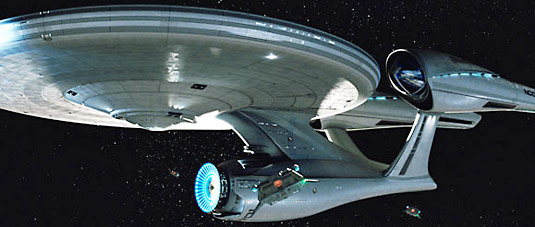
Remember what I said about not messing with the cast? It goes triple for the Enterprise. Looking at this re-design, and the horrible and cramped styling salon that passes for a bridge, I felt sure that Montgomery Scott himself would slingshot himself to 2009 and personally kick J.J. Abrams ass.
That's not the bridge of the Enterprise... it's an Apple store.

So my expectations going into this movie were basically, "this is going to suck."

Well, now I've seen the new Star Trek movie, and contrary to my expectations, it didn't suck. It didn't just entertain. It rocked! Now for the spoilers.

It's a re-boot alright. A very pissed off Romulan (Nero, played by Eric Bana), goes back in time after the destruction of Romulus. His intent is to destroy Vulcan and the Federation, thus pre-emptively avenging his homeworld. His first act: he destroys the ship on which George Kirk, father of James T. Kirk, is serving. Growing up fatherless, Jim Kirk doesn't rush off at the first possible opportunity to follow his father into Starfleet, choosing instead to be the dysfunctional "rebel without a cause". Nevertheless, he's talked into Starfleet by Christopher Pike, years after he would have otherwise joined. There he meets the crew we've all known.

Now, you can already see a departure from the original Trek universe... and it makes perfect sense. Kirk is no longer the "stack of books with legs" described by Gary Mitchell. In fact, Mitchell doesn't appear at all, having graduated in an earlier class. Kirk's assignment on the Farragut never happens, as he spent it riding motorcycles, chasing skirts, and getting drunk.

Even the design changes to the ship make sense. Here's my theory... a brilliant young engineer (let's call him "Ensign Matt Jeffries") was aboard the USS Kelvin when Nero destroyed it. Thus he was never assigned to the engineering design section of Starfleet, and all of the influences that he would have had on the design of the Enterprise were missing. Thus we have the squat, pipe-laden thing of the movie rather than something much cooler, like this:
Along the way, we discover why Spock turned down assignment to the Vulcan Science Academy, earning Sarek's ire for all those years in the original series. But a major, yet necessary, departure from the original canon prevents the same rift from forming in the new continuity. We learn why McCoy is called "Bones" (it's not short for "sawbones"). And we see Uhura and Chekov more competent than we've ever seen them before. We also get to see a bit of where Montgomery Scott may have wound up without a Captain Jim Kirk to request his posting to the Enterprise.

The casting is excellent. I had doubts about some of the choices until I saw them doing their jobs. Chris Pine is not the Kirk we remember, but he can't be, given the significant differences in their backgrounds. But over the course of the film he becomes Captain James T. Kirk, and in the final scene he is most assuredly the same officer that William Shatner brought to life. Zachary Quinto is excellent as Spock. Again, this is not exactly the Spock we remember, nor in this case does he become that Spock. This is as it should be, given the events of the film. Never mind, Leonard Nimoy as the old Spock is still around to provide continuity and step into a mentoring role. Tossing aside the calendar and considering only his personal timeline, he winds up being quite possibly the oldest Vulcan in the galaxy. Karl Urban probably provides the best characterization. He has nailed McCoy. You won't see this as an impression of DeForest Kelley, but you can't help but watch Urban and say, "Yes! THAT is McCoy!" (though I still think that physically he's a dead ringer for the original "Gary Mitchell", Gary Lockwood) Zoe Saldana will have an entirely new generation drooling over Uhura. Anton Yelchin is far removed from Walter Koenig; nevertheless, he brings the right mix of youthful exhuberance and over-achievement to the role of Pavel Chekov... if anything, the accent is thicker, but it's more authentic. John Cho doesn't have a lot to do as Sulu but be Asian and athletic, but he does both naturally. Long known to be a fencing enthusiast, in this movie Sulu has a folding katana that everybody is going to want). But my personal favorite has to be Simon Pegg as Montgomery Scott. He simply steals every scene he's in just by being there. Scotty has always been my favorite character, and having one of my favorite actors portray him was a nice extra. And while Pegg's home in Gloucester isn't exactly Glasgow, Pegg does a much more believable Scots accent than Jimmy Doohan. (I spent enough time living in the UK to appreciate the difference.) Everybody really did a first-rate job.

There are some things in here just for us Trekkers: just about every word out of McCoy's mouth; Captain Pike in a wheelchair; the way Kirk bites the apple during the Kobayashi Maru test; the Alexander Courage theme music; mention of Admiral Archer's prize beagle.

That's it for the gushing. There were a few things I think could have been subdued or done without... there's a scene in Engineering that could have been stolen from Charlie and the Chocolate Factory. When I saw it I couldn't help but think they were channeling Galaxy Quest. Let me just say that there's no reason for giant chompey things, and there's no reason for what's in the new Engineering, either. Perhaps it's useful to tie the Star Trek universe to the present day, but I could probably do without the product placement, as well.... although knowing that Nokia will be around in the 23rd century should put investors' minds at ease (except for that "no money in the future" thing, of course).

And here's my hard-core Trekker's complaint. There's one thing in the movie that can't be explained away with retcon or alternate timeline. At one point, Kirk is stranded on "Delta Vega", which we know from the second TV pilot as a dry, deserted world that's home to a an automated lithium cracking plant. It's located on the very edge of the Galaxy. We know it as the world where Gary Mitchell died. It's hell and gone from Vulcan. And yet in this movie it's a frozen wasteland with the planet Vulcan looming large in its sky. Rather than Delta Vega, this can only be another moon of T'Khut. They could have called it almost anything but Delta Vega and gotten away with it. But this is a minor quibble, which I'm going to put down as a bug in the Federation database.

But all in all, this movie gets two thumbs up from this Trek enthusiast.
I just wish they'd fix the ship. Maybe it'll grow on me.

Now, here's something interesting from the parallel universes department. Compare the new movie's plot with Tim Russ' Of Gods and Men (available for free download on the Internet). In OGAM, Charlie Evans goes back in time to kill Jim Kirk, removing him from the timeline and severely changing the Federation. It's worth a watch.

Thursday, May 07, 2009

New Music: In My Memory

"In My Memory" is a song William Hoover and I wrote for the 2009 Boogaloo Folk Life production of "Can't Live With 'Em". You can probably guess from the title that the theme is relationships.


Now, my opinion is biased, but I quite like this one.


Saturday, May 02, 2009

New Music: Billy Jean

Believe it or not I've actually recorded Billy Jean. It's crap... don't say I didn't warn you.

I sincerely hope it inspires someone to go forth and do a better job so I can link to their version instead. As usual, it's released under a Creative Commons - attribution, share-alike, non-commercial license to make that possible. If you think you can make money with it, then more power to you... write me for permission to use it commercially.

Wednesday, April 15, 2009

Tea Parties: Obama Doesn't Get It.

(Oy veh. I tried posting on this topic on the 15th and Blogger lost it during the post. Did I mention I hate web apps? Well, I do.)

On "Tax Day", April 15th, 2009, thousands of Americans turned out to protest at hundreds of "tea parties" across the country. Sadly, the President doesn't even begin to understand the nature of these protests or what the country wants. He thinks it's a motivated by selfishness. Says White House press secretary Robert Gibbs:

"If anybody involved looks at the facts, they'll find out that this president promised and this president delivered on putting more money back into the pockets of hardworking Americans, cut their taxes, made it more affordable to buy a home, made it more affordable to send their kids to go to college, provided tax incentives for businesses to create jobs through things like clean energy," Gibbs told reporters during an afternoon press conference.

Says David Axelrod, a top Obama advisor:

"The thing that bewilders me is this president just cut taxes for 95 percent of the American people. So I think the tea bags should be directed elsewhere because he certainly understands the burden that people face."

Yes, bewildered. This is unsurprising from a crowd who's entire modus operandi is to pander and bribe their constituencies. The very same day that these people took to the streets to protest, the President reminded the masses that he was "giving" them that which belonged to them in the first place.

Bribes and pandering.

But here's a clue: it's not about higher taxes (though that's a part of it). It's not about a complicated tax code (though it could be simpler). It's about the way our taxes are spent.

Here's someone who gets it. My governor, Mark Sanford of South Carolina, has turned down $700 million in Federal stimulus money. Why? Because it commits the state to continue spending at levels that it cannot afford once the stimulus money is gone and Obama himself is long gone. The money comes with strings that saddle the state with long-term financial ruin.

This isn't a new thing... we've seen this before. Just in my neck of the woods, in Union County, the town of Carlisle used to have only one police officer. Just one, but in a town of a few hundred people that's all you need. In the mid-90s, Bill Clinton promised to put 100,000 new cops on the streets of America, and to fund them for three years. Carlisle took the money. However, the legislation required the town to continue the funding afterwards. Today, Carlisle has no police officers: their budget was broken. And this isn't something that just happened here... here are some other folks that remember the experience and have no wish to repeat it.

This administration just committed to trillions of dollars of spending, much of which -- most of which -- is unnecessary. Over 800 billion spent without accountability. Banks forced to accept "bailout" money when they're profitable. (Keep in mind when reading the linked story that stock prices and profitability are completely different things. Everybody's stock prices are down from last year.) The Federal government telling private businesses who they must fire. Handing automakers "bailouts" which do nothing to improve the sustainability of the automakers, but everything to preserve the outrageous costs imposed by their UAW contracts. Revising these contracts will absolutely require bankruptcy proceedings, meaning the only thing the "bailout" has done is evaporate $17 billion... GM and Chrysler will go bankrupt anyway. Meanwhile, Ford refused the Federal money and slashed costs and re-negotiated union contracts on their own. There is no irony in the fact that the only automaker to refuse government bailout dollars is the only one to show positive results.

Let us not forget that this whole financial mess began with the housing market, and it began with the government mandating those stupid high-risk loans in the first place. That would be the Clinton administration, by the way. Look it up... it's Public Law 106-554.

If you've been paying attention at all, you know this: it's not paying out taxes that we're protesting. It's the piss-poor stupid uses to which those taxes are put. It's the fact that in an epic display of hubris, Obama plans to do everything at once without the pesky annoyances of budgeting and planning. It's the fact that he has put the future of every American at risk for decades, and it only took him one fiscal quarter to do it. It's the fact that politicians of all stripes have been perpetuating this irresponsible behavior for years. Nevertheless, our President and his advisors are "bewildered" by the protests. They think we want more freebies and gimmees, and plot to steal ever more money from our employers to hand it out, rather than creating the conditions by which we can earn vastly more.

There is no reason for such ignorance. Perhaps if our "representatives" actually watched the coverage and listened to the participants had to say, then they wouldn't be so bewildered. Perhaps if the other networks had seriously covered the events instead of making fun of the participants then they wouldn't be upstaged by bloggers. As it is, the only people who are surprised by this are people who are completely out of touch with the heart and soul of America. If, as Nancy Pelosi believes, the tea parties are orchestrated by Fox News, then she's in serious trouble, as Fox's ratings clearly show. She should be quivering, and I'm 100% certain that privately she is. The tea parties aren't going away. Mid-term elections are in 2010, and anyone who desires re-election has a simple choice: oppose this course of reckless spending or be voted out of office. We have had a taste of Obama's "change", and it sucks.

Tuesday, March 24, 2009

Oy, veh.

I'm not commenting on Obama's speech tonight. I'll wait for a transcript first.

Monday, March 23, 2009

Wealth, Capitalism, and Greed.

I'm not super-rich. By the standards of this country I'm not even sort of rich. As I'm fond of saying, I want to make a living, not a killing. I'm a single wage earner in a household of six people, for cryin' out loud. But I paid attention enough when I was a kid to know how well off we are today.

My father was a native American. He was born in this country with nothing. My grandparents on my mother's side were Hungarian Jews. They arrived in this country with nothing. My stepfather was born in 1922 in Andersen, South Carolina. He went to school in a one-room schoolhouse with no plumbing. At lunch the children would get drinking water from the creek. That's because that's how people lived. He once confided to me that when he was 12 years old he never imagined that he would one day be rich enough to live in a painted house. All of these people came from the poorest of the poor. They all made something of themselves. Remember that phrase.

Why is it that some places in the world are wealthier than others? It's not about natural resources; Switzerland and Japan prove that. It's not about taking or withholding from others. It's not geography. For instance, during the cold war, West Germany created wealth at a breakneck pace while East Germany did nothing. How did that happen?

It has everything to do with Capitalism.

Wealth is not a zero-sum game. You can create wealth directly out of your imagination, as an author does when writing a book. J.K. Rowling's net worth is roughly a billion dollars. Yet her only real assets are the products of her imagination! And this isn't some kind of trick accounting that simply to account for money that she sucked out of other people... When she wrote Harry Potter and the Sorcerer's Stone, she had something of newly created value even before it was sold. This is literal creation of wealth. Wealth is created when human beings use their imagination to produce something new... something that someone else wants. This is capitalism.

Capitalism is not about greed. It's not just about acquisition. It's about reaching a level of comfort and satisfaction that's right for you, whatever that level may be, and not having impediments to the attainment of those goals. Capitalism doesn't promote the collection of wealth at the expense of other people. Rather, it's about creating an economic environment where anybody can succeed. Remember, it depends on production to work. and capitalism has worked so well in this country that not only can anybody succeed, nearly everybody does. In industrialized countries like the United States, capitalism has raised the level of the "poor" beyond the definition of "rich" in the rest of the world, as our workers are paid to participate in the creative process and share the rewards. You don't believe it? Go visit some other countries. There, it's a blessing to simply eat, and having no shoes is normal. What we call "poor" in this country is anything but poor. Here it's a shame not to have a television or new shoes. This is because our "poor" work for capitalists. (There are some real poor in this country, but they are very few. That's not a consolation for those who are poor; it's simply a fact.)

The redistribution of wealth -- socialism -- is not about creating anything. Rather, it's about taking the wealth created by someone else and simply spreading it around. It might sound great on paper (between the covers of the Communist Manifesto or Obama's economic plan), but in practice it falls apart almost immediately. That's because once you go down this path; once you vilify and steal from the entrepeneurs to give to the idle; once you've spread all the cash around, you soon discover that there's no more to spread. The cash flow... doesn't.

Witness the Soviet Union. Despite the iron fist of a government willing to use its military against its own people, it fell apart not because of foreign military opposition, but because they couldn't pay the bills. It fell because SOCIALISM DOESN'T WORK. Why? Because socialism removes any incentive for creation of wealth by stealing that wealth from the people who created it. Without incentive, entrepeneurs cease to take risks and artists become daydreamers. They cease to create wealth, and there's no one left from whom the socialists can steal.

The redistribution of wealth is motivated by envy and greed. It's not about improving your own lot... it's about taking something away from someone else so that they are more like you. It's about institutionalized theft. It's saying "I want what he has, but I don't want to work for it. I don't want to create wealth, I want to steal it." It's about the promotion of class warfare; it deliberately incites people to alienate themselves from the people most likely to help them succeed. In so doing, it perpetuates hatred and distrust and mediocrity.

Leading the charge to institutionalize this despicable behavior is our own President, Barack Obama, who waved the promise of change, but failed to mention that it was most assuredly change for the worse. After enduring a week of this Administration's inept blundering, I I experienced the proverbial "final straw" this morning when an Administration apologist defended the admittedly socialist agenda by ignoring every question he was asked in order to repeatedly decry the "discrepancy between the very rich and the very poor". Folks, this "discrepancy" is a red herring. It's a distraction to keep you focused on envy and greed to keep you from realizing some very true things:
  • First, someone else's good fortune is not your misfortune. Remember, wealth is literally created from imagination and effort. As such, the potential for wealth is unlimited.
  • Second, you can create wealth for yourself. You have as much opportunity as anyone else. If you have ability as well, you will be successful.
  • Third, even if you lack the ability to create wealth, you can work for someone who does, and thus collect wealth by assisting with their creative efforts.
  • Fourth, our economic problems will not be solved with redistribution of wealth, bail-outs using borrowed money, and taxation.
  • Finally, if you open the door to stealing someone else's wealth, it will happen to you, too.
Remember that phrase? "They made something of themselves." In the capitalistic society of the United States, that statement is literally true.

My father joined the military, then the fire department. He never made a lot of money, but that's not what capitalism is about. It's about reaching your level of comfort and satisfaction. He was a fireman; he saved lives.

My mother's parents worked hard and mastered the English language. They made their own way without public assistance, and contributed three children to society: My Uncle Ben became a successful anesthesiologist; Uncle Vic was a translator for the US Army; and my mother, Lillian, was an amazing seamstress and factory worker who managed to provide a comfortable home for her children (and hers is an incredible story by itself).

My stepfather, Terrell, who ploughed with mules and drank from the creek, was a proud Marine who joined the rest of his generation in literally saving the world from tyranny. After World War II he became an engraver and was eventually foreman of the engraving department of the largest newspaper in South Carolina. He bought the land on which stood the unpainted house in which he was born and ran it as a Christmas tree farm in his retirement.

These weren't amazing tales of rags to riches; they were just ordinary folks who, starting from nothing, earned themselves ordinary, comfortable lives. But all of them believed that you are limited only by your imagination and desire. In the country they were born in, migrated to, and fought for, this was true. I hope it remains true in the years to come. I'll have more words on that tomorrow.

Friday, March 20, 2009

A story and an endorsement

Good Lord! I haven't updated this blog in months. Have I been that busy? Well... yes, actually, but that tale can wait. As for right now, I'm waiting on a script to finish running on my computer, so I'll post this little story:

On December 6th, 1985 I was in an auto accident in the UK. I remember the date vividly, as this was the opening night of Guys and Dolls, and I was in one of the lead roles, Nathan Detroit. I was driving a Pontiac T-1000 (basically a Chevette. It was similar to the photo shown here, but with the optional "European styling package" consisting of an air dam and spiffy hubcaps.), and I hit a long patch of black ice on the A43 south of Brackley.

The funny thing about this sort of accident is that you've got time enough to plot the Great American Novel in your head, but you don't have time to react to anything. Your muscles simply don't move as fast as the millions of synapses that all activate in your brain under stress. I hit the brakes, which promptly locked up. There was no ABS on that car. I tried steering onto the verge with no luck, as I'd already lost traction completely. There was no airbag on that car, either. The only thing left to do was brace for impact as I approached the rear of another car and wonder how my wife and parents were going to react to my imminent death, for I was fairly certain I was about to die.

I didn't die, obviously. But both of my legs went through the plastic dashboard, which shattered, ripping large gashes my knees through which you could see the kneecaps. This happened, of course, in slow motion, and it was excruciatingly painful.

As a result of this accident I learned exactly how much better made a Mercedes is than a Pontiac T-1000. The car I impacted wasn't damaged. At all. My car was a total loss, as were the trousers I was wearing. I pushed my car to the side of the road and continued into town on foot. (No. The other driver did not offer me a lift.)

Did I mention this was opening night, and I was playing the lead? Good. Did I mention there was no understudy? Well, there wasn't. So I smeared some petroleum jelly in my wounds, wrapped my knees up in Ace bandages, and called someone to come get me. I was determined to do the show, then go to the hospital. The show started late (not my fault... we were waiting on the pianist), and the curtain went up.

Now, what I'd forgotten in my noble adoption of the maxim "the show must go on" is that there is a moment in the play where Nathan Detroit (that's me) begs for the forgiveness of his fiancee of 14 years, Adelaide (played by Deston Lee). It was completely out of my head until I dropped to my knees to deliver the line "Adelaide! I'm on my knees!". Imagine if you will three-foot long hot skewers pummeled into your knees with a large mallet. Imagine they're inserted lengthwise through your femur, all the way up your thighs (both of them), and that they continue all the way up to your armpits. Imagine all of the fluid displaced by these skewers erupting from your tear ducts in twin geysers of saline. I didn't expect that!

Nevertheless, I dutifully bawled out my line and waited for the reaction. Deston turned toward me, and the look on her face was something not easily forgotten. Though this was not the line, written clearly on her shocked expression was "Oh, you poor man, of COURSE I'll come back to you!" Then she visibly overcame that impulse and continued with her lines, totally appropriate and in character. To this, my internal reaction was, "Wow, she really can act!"

We finished the show, and I went to the hospital, and was told that all the dancing and movement was probably the best thing I could have done to retain my mobility. I didn't tell them the part about dropping to my knees. To this day I've got some rather incredible scars to remind me of the story.

Another reminder comes from the fact that I recently spoke with Deston's husband Bill Lee, who directed this play and who played Inspector Brannigan in some of the performances. As you can read on my drama pages, this was an ambitious production. We started with borrowed facilities, no costumes, no sets, and no budget. That didn't deter Bill in the slightest. The production was done mainly through the force of Bill's will. Not only that, but we took it on the road and performed it to benefit local causes in the Midlands. One of the things I learned in the course of that production is that William Lee can get things done. This is a man who has never looked to someone else to solve his problems. And he has a positive, practical, effective approach to any task he faces. There are real, long term problems that this country is facing right now, and to solve them we need people like Bill to get involved.

That's why I'm glad to hear that Bill is running for the position of US Senator from Illinois in 2014. That sounds like a long way away, but when you're starting from ground floor you need to plan ahead. If you're in Illinois and you're reading this, read Bill's blog, contact him, talk to him, look for his speaking engagements, and support him. You'll be glad you did.