Friday, July 01, 2016

Color and Design: Some Reactive Thoughts

MakeUseOf offers the following headline: "How Much Does Color Matter in Design? More Than You Think".  While I've often wondered why headline writers presume to know what I think, that's not today's subject. This MakeUseOf article is really just a very short observation accompanied by a detailed infographic from MastersinPsychologyGuide.com. I'll share that at the bottom of this page since they invite it.

Earlier in life, I was a commercial artist. I painted business signs, banners, ads on buses, etc. This was in the days before Photoshop, before laser and inkjet printers, and before much of anything at all, really. We made our own silkscreens, mixed our own colors, and drew our own designs. We painted on boards or canvas using sable brushes.

My buddy William was "da Boss", and the primary artist. But here's an interesting Fun Fact... William has deuteranopia... what you would call "red-green color blindness", which means he could see about three colors: blue, yellow, and what he describes as "beige", which is everything else.

So how does a guy with defective color vision make it as a commercial artist? Glad you asked!

It's a matter of composition, theory, intellect, and compensation.

First composition. While color is important, it's not the only important thing, nor is it always the most important thing. You'd know a Coca-Cola logo immediately if it were rendered in black-and-white. You'd even know it without the word "Coke", from the swoosh alone. Bold, simple shapes matter most. And that scales up to the composition of an ad, not just logos and components. The items placed in a space make a shape. Good artists control that shape. The negative space between those objects also make a shape. Great artists control that, too.

William excelled at composition and rendering a subject, and at selecting and/or designing the proper lettering to use in an ad. You'd call them fonts. He also draws very well. If you've ever held a pencil you know that this part of the process is not color-dependent.

Furthermore, lack of color is significant. Those of us with full color vision are used to it. So heavy blacks and bold contrast can be as impactful as color or more-so.

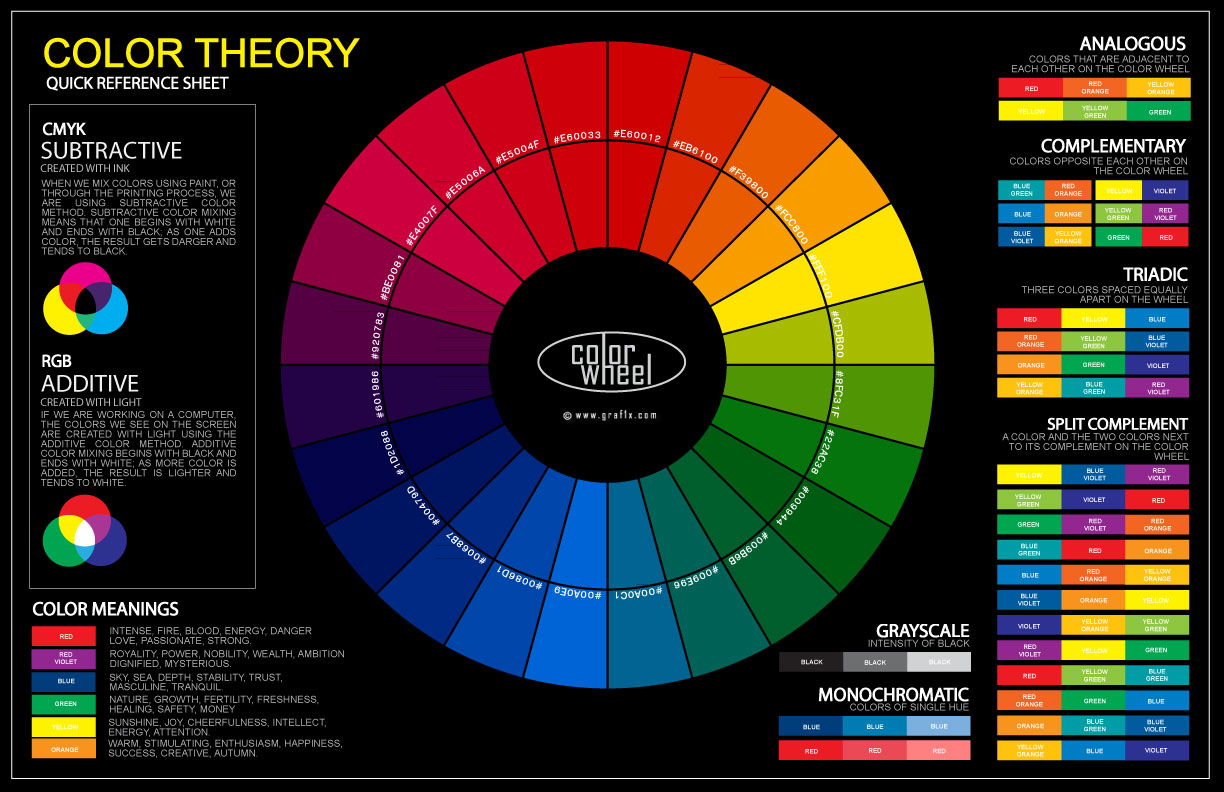
Next, the theory. A color wheel is invaluable. With a proper wheel, you know how colors can be blended to form new colors. You know what goes together and what clashes. For a color-blind individual this can be largely theoretical, but it can work.

Color Wheel. From graph1x.com
The primary colors are different when you're using subtractive colors (pigments) vs additive colors (light). We used paints, so the colors were subtractive. That is, primary colors are formed when light is absorbed by the pigment, reflecting what's left. Color is subtracted from the white light. Additive colors are from light transmitted directly to your eye. Colors are added together to form new hues.

You also need to know what the colors represent emotionally. For instance, the top half of this color wheel contains colors that are considered to be "warm" and "exciting". The bottom half has colors that are "cool" and "calming". Greens are associated with finance, prosperity, growth. Pinks and purples are emotional or counter-cultural. I know the wheel there says purple is "royal", but we don't have a whole lot of royalty in the 21st century. For a long time now the "mysterious" aspect of purple has been used in New Age imagery.

The point here is that even when you can't see the colors in question, you can know that they exist, and you can consciously design things emotionally, choosing colors from a palette. That's where the intellect comes in. You ask, "what do I want to communicate in this ad on a subliminal level? What do I want the audience to feel? What emotions do I want them to associate with this product or service?" and you design your palette accordingly.

If this sounds terribly manipulative, that's because it is. ALL art is manipulative. In its simplest, most accurate definition, Art is the process by which emotion is deliberately communicated from the artist to the audience. At least, that's my opinion and formulation of it. I created that definition because it describes all art, whether it's painting, music, dance, sculpture, poetry, photography... you name it. To be art, it must be deliberate, and it must be emotional, and it must be felt by the audience. Without those criteria, pretty things are the work of craftsmen, not artists. I continue to use the phrase "commercial art", because emotion is a major consideration. You the audience do not always notice it, but it still makes you buy things. You develop an affinity for a logo or design. You form an attachment to the manufacturer that is independent of the objective quality of their products. And you don't even know why. But the artist does. He made you do it.

What's left is compensation. William, for example, had trouble with hues, but he was exceptionally good at discerning shades. You may find an artist with this perception producing works that are somewhat monochromatic, but which have great depth. Paints and dyes are clearly labeled with reference numbers matching the color wheel. Every job begins with a clean palette. No guessing at what's there un-labeled.

And he had me to double-check a design or suggest color changes. I also matched pre-existing color-schemes provided by the client. Everything was mocked up on paper before it was committed to paint. Formulas for mixing colors were written down.

Finally, as sort of broad filter, I gave William a pair of red-green 3D glasses from the cinema where I worked a second job. Through the red lens, reds are washed out and greens look black. Through the green lens, greens look washed out and the reds are black. It's not subtle or pretty, but it's OK for getting in the right ballpark. You can at least tell that the colors are different, and you can pass one of those color-blindness tests with the dots.

And that's how it's done.

In graphic arts, a lot can be communicated with placement, but to communicate emotion, color is it, even if that color is simply black.

These days there are even better glasses. Much color-blindness is because of weak color separation rather than missing, and a company called enChroma has developed a lens that can improve that separation and help the color-blind discern colors.

For those who have lived with color their entire lives, the effects are subtle, but introducing it where it's never been has tremendous impact. Think of the 1939 Wizard of Oz film where Dorothy moves from black-and-white Kansas to Technicolor Oz, and the effect it had on those audiences. Now look at how color emotionally affects someone by its mere presence:


There are many more videos just like it. Search YouTube for EnChroma.

And here's that infographic. There's an anecdote after:

++ Click to Enlarge Image ++
Psychology of Color in Unicorn Companies  - MastersinPsychologyGuide.com - Infographic
Via: MastersinPsychologyGuide.com


A Personal On-the-Job Story:

What I learned about art in the sign-painting business has been applicable to software design throughout my career. Now, I'm no Frank Lloyd Wright, but just as he designed buildings that blended with their environment, I like to design software that reflects its use.  For instance there's the casual look of my "manage-everything" software, VIC:


If Salesforce.com is all about the Enterprise, VIC is blue jeans and a handshake. Then there's the back-office management software I wrote for the now-defunct Discovery Zone. DZ managed indoor playgrounds for kids, and the software's design scheme reflected that: bright primary colors and simple, bold fonts.

After DZ I was hired to write some commodities-trading software for a rather large firm... this turned out to be their first billion-dollar year. I wanted to make it convey "wealth" and "success", so I went with greens and greys and golds. The color and texture of money. I also wanted to make buy and sell opportunities visually pop, so buy opportunities were in green and sell opportunities were in red.

So I mocked it all up and showed it to the Director of Marketing, who was sponsoring the project. He didn't "get it". He was completely disappointed, to the point of literally pouting, that I hadn't used garish, clashing "Hot Dog" colors.

It was in this meeting that we all discovered he was color-blind.

I went back and did some re-design so that buy opportunities were in an italic typeface and sell opportunities were bold. But I kept the colors. I explained, as gently as it was possible to do, that although he was paying for it, the audience for this software was far broader than him alone, and it had to visually appeal to that audience. Since he was working at a disadvantage, he should take the good advice of those who have a full spectrum at their disposal. I promised to nonetheless work with him to make it as easily usable and visually appealing for him as possible without detracting from its marketability.

I don't think anyone knew of his color-blindness until that meeting. They simply thought he had a terrible fashion sense. I also firmly believe that he had never until that moment thought of his color-blindness as a disability. He wasn't terribly happy with me for highlighting it.

But what I learned from that was to adopt a few rules of thumb.
  1. If you can make colors configurable, do so.
  2. Don't rely only on color. Typefaces, icon badges, and indicators are invaluable.
  3. Useful icons are all about contrast. They should look as distinctive under any palette or in greyscale as they do in full color.
  4. Icon badges should be colorless. Plain black. Remember what I noted at the top of this essay about Coke's logo.
  5. Use tools to test how something will look to the color-blind. Something that looks good to you may be literally invisible to someone else.
  6. Know that if you use words like "defective", "normal", "deficient", and "disability", or "disadvantage" someone might get angry or hurt. You may feel nervous about that if they're paying you,  Personally, I don't let that stop me any longer than it takes to explain the context. If you can't see what I see, then you're at a disadvantage. It's a fact, not a judgement: let's move the conversation along.
For small images and sample screen snippets, Coblis is a good tool. It's a Color Blindness Simulator. For entire web pages you could try the Colorblind Web Filter. It's slow, though, and can be confused by linked images. Both tools let you select the type of vision you wish to simulate.

And that's all I have to say about that.


Saturday, June 11, 2016

Why I'll Vote Libertarian in 2016

Let's see if I can keep this short and to the point.

Those who know me know that I'm a fairly conservative human being. When you look at the Libertarian candidate for President, Gary Johnson, and his running mate, Bill Weld, you can see that though they are Republicans, they're anything but conservative.

Oh, they're fiscally conservative, yes, but they're socially liberal. To a lot of people that's what "Libertarian" means. So why should I support a Libertarian candidate for President who promotes drugs, gay marriage, and on-demand abortions when I do not?

Because "fiscally conservative, socially liberal" isn't what "Libertarian" actually means. "Libertarian" means that I'm not bent on controlling people over things that are none of my business. It just coincidentally happens that this means being for small, unobtrusive government in both fiscal and social matters. LIBERTY is in the name. A Libertarian generally believes that you should be able to do as you want, so long as you don't hurt others in so doing.

It's as simple as that.


"How can you vote for THAT?"

When it comes to marriage and abortion and drugs, I disagree with many Libertarians, Gary Johnson included. But here's the important part: When Johnson says he's for any of these things, it's very different from the same statement uttered by Hillary Clinton or Donald Trump or Bernie Sanders. It means he, personally, is in favor of it. It does not mean that the Federal Government should be taking a role in legislating it.

Personally, I don't care what you believe so long as it doesn't cause you to infringe human rights. With a Libertarian, there's little chance of that. With a Republican or Democrat, the chance is 100%. There is an absolute certainty that a Republican or Democrat will seek to infringe your rights. The Libertarian will seek to keep the Federal government out of those things that should be locally determined. A conservative Libertarian and a liberal Libertarian can agree that most of the things on which they disagree are outside the scope of government.

There is a very big reason why strong centralized government is the stupidest human invention ever devised, the atomic bomb not excepted. It's because when the government is decentralized and local, people are free to vote with their feet. If their community has intolerable laws, they can pick up and move to some place populated by like-minded individuals. If you don't like living in a dry country, move to one without prohibition, and so on. By allowing people freedom of travel and the freedom to form their own local governments, a nation was born that allowed people of widely different opinions to live in relative peace. And if people are draining away from your locale and you're losing your tax base and your quality of life, that's probably because you're being governed by dickheads. You can either change your ways or recognize with honest self-satisfaction that you're one of them and that this is the price you pay for making your locale a sorry place to live. Market pressures work on populations and laws when there is freedom to govern locally.

However, when people are not allowed the freedom to self-govern and there is no recourse for them to move, they consistently grow more dissatisfied. You can see it yourself in the news. The more you want the central government to do, the bigger the political divisions, the bigger the more violent the discord, the more strident the voices. This includes the violent, hateful Democrats who storm Trump rallies and who hypocritically claim that in throwing the first punches against those who have thrown none, they're actually combating the hatred of others. That's hypocritical bullshit. The rhetoric may be Trump's, but you bring your own hatred with you, and it doesn't know your Party.

The price of your own freedom is to allow others to have theirs. That's what being a Libertarian is about. It's about living as if you actually believe in the Constitution you claim to support. It's about throwing aside your hypocrisy. 

So yeah, I can vote for Gary. We may have differing opinions, but you know what...? This is the United States of America. We're supposed to have differing opinions. We're supposed to be a Mulligan Stew. The only thing we must agree on if we're to remain Americans is that Liberty and Justice is for ALL, not just the ones who believe as you do.


On Being Libertarian (Concise Version)


Let's see if I can make that last post more concise.  Here are some of my political beliefs:
  1. I think that the government should stay out of business. There are an awful lot of things that are regulated in business that need no regulation, or would be improved without it. Many people are upset by "legislation by the courts", but I vastly prefer it to "legislation by regulation". First of all, court decisions are the basis of Common Law. "Legislation from the bench" is, in fact, the most concise description of Common Law I know. This gives an opportunity for evidence to be presented, heard, and considered, whereas "legislation by regulation" offers exactly none of that. Regulations are not laws, but have the force of Law. They are created by people who are hired by people who are hired by other people who are appointed by people who are elected yet have no desire to understand or monitor the thing being regulated. And the tighter the regulations are the stupider it gets. By contrast, we can have a simple law: "Do not murder", and let judges and juries decide whether a thing is or isn't murder. We don't need to create endless regulations prohibiting murder by every conceivable instrument and call it a "loophole" when someone is bumped off with a novel weapon. Likewise, we don't need endless regulations to keep things safe in general. Between the courts and the market, the quality of life will continuously improve without micromanagement.
  2. I believe in a free market, and that includes the labor market. Without a minimum wage at all, then the effective minimum wage is whatever the market will bear. And if no one will work for you for $7.50/hr, then you will pay higher than that. That's how markets factually work. As an example, Denmark has no nationally mandated minimum wage, but people are paid more because they will not work for less and employers cannot use a minimum legal standard as a crutch in their wage negotiations. But despite the whining of millennials, there are jobs that aren't worth a whole lot, and people who are not yet skilled enough to command the average living wage. They should not be prohibited from marketing themselves and gaining what they can for their skills simply because employers are prohibited from offering what they are worth, and therefore cannot hire them at all.
  3. I believe that abortion is murder, plain and simple. And murder harms others, so should be illegal. I believe the science is 100% completely on my side here. If you take samples of the DNA of a mother and fetus to a lab without any further sullying of the information and simply ask if they came from the same person, the answer is a solid "No". Every time. And though you may be perfectly within your rights to kill your own body, that doesn't go for the body inside it. But murder is not a Federal offense except under exceptional circumstances. Such matters should be left to the States, and to the extent that it's conscionable, to conscience. But late-term abortions are unconscionable.
  4. I don't do drugs, except sparingly and fleetingly as a means to combat a disease. But if you can't do what you will with your own body, then you don't own it. And if you don't own it, who does? My response to anyone who wants to control what a consenting adult willingly places in his own body is, "who the hell do you think you are?" If they are being completely honest, they cannot escape the fact that the answer is always, "YOUR MASTER". It's perfectly appropriate to tell such an individual to go pleasure themselves with a thistle. I hate drugs, but I despise slavers.
  5. I believe that marriage is a sacrament, and is properly described as a union between a man and woman. However, that's a religious opinion, and pursuant to the First Amendment, the Federal government has no business legislating religious affairs. Therefore, to the fullest extent that I feel God instituted marriage, I feel that the Feds have no business in it. None whatsoever. I should not need a "license" (i.e. "permission") from ANY government to get married, and I feel that our Federal government is especially prohibited from granting it. Such things should be left to the States that have not similarly prohibited religious legislation in their own constitutions.
  6. I don't give a single shit about your genderever. It's not my business. Your biology is another matter. Your local government is free under the constitution to institute laws. It doesn't mean you have to like them. But we are always free to move and associate with like-minded individuals.
  7. We have an army for one purpose only. Seriously, they have exactly one job. That job is to defend the borders of the United States. The fact that we also have a Border Patrol is ludicrous. The fact that we have porous borders because we refuse to allow the Army to do its One Job is ridiculous. I am pragmatic enough to realize that we can only maintain our liberties if our voting citizens are those who adhere to just one non-negotiable condition: the acceptance of the principles of our Constitution. Every other thing is completely up for grabs. But if you're allowing hordes to immigrate without that stipulation, you're not a nation.
  8. Our foreign policy should be modeled our domestic policy. That is, nations are free to do as they want so long as they don't harm others. When they do harm others, then our general principle should be that the aggressor is at fault. But this is balanced against the rights of other nations to govern themselves, so our actions should be well considered. I personally have no objection to freeing a nation from the rule of a despot, assuming the people want to be freed. But it's silly to do that and then run, or just pay for someone else's security. You want the freedoms of America? Be American. I'm perfectly fine with colonial expansion, so long as it's requested.
Other Libertarians thing differently. Sometimes, vastly differently. That's OK. 


Saturday, June 04, 2016

On Being Libertarian

For me, it probably started with

Now, let me start with recognizing that I'm a right bastard when it comes to argument, particularly online. You could find an example of that here, or especially here. I don't "fight fair". I rhetoric. I use emotionally charged words. I'm vastly more inclined to do this in print than in person because I don't have the kind of time to explain things the same way in print that I would in a face-to-face conversation. In a personal conversation you can see my face; you can hear my voice; I can put body language and expression to good use, and I can respond to your questions, even when they're unvoiced (I can see you too, y'know). In print I can't do any of that. So if I want to communicate in print that something is horrific, or stupid, then I often just have to say it. Sadly, too many people are unused to hearing people say what they mean.

But on the flip-side; in print, I do have the luxury of taking my time... so the vast majority of the time, as Humpty Dumpty said, "When I use a word it means exactly what I choose it to mean -- neither more nor less." (Of course, the message I send with those words is very different from Humpty Dumpty's)

What you don't know from looking at print is that every argument that I have ever had on-line is an argument that I have already had with myself. I therefore have the luxury of actually listening to your side and paying attention to what you're saying, and responding to that instead of selected "sound bites". I argue with myself a lot, and I argue both sides equally strenuously. And when there's more than one possible response, I go back and explore every one I can think of. And if you think I'm unfair in print, you should know that I am absolutely brutal with myself. I am far harder on myself than I have ever been with any other human being. Even when I tore Euqid to shreds I did so in a way that was without malice and employed humor. I don't have to bother with that when dealing with myself.

I don't care who you are. If you are brave enough be brutally honest with yourself, one of the first things you realize is that you are a fucking hypocrite. Republican, Democrat, Emocrat, or Libertarian, you're a hypocrite. And I'm talking to you reading this. If you call me on the phone or visit me in person, I'll look you in the eye and say it again. You have to cultivate honesty, and practice it uncompromisingly on yourself so as to minimize its effect on your behavior.
Note that if I quote you in an example of hypocrisy or if I look you in the face and point out your hypocrisy, it's not in a pejorative sense. Rather, it's a statement, like "Boy, you sure are tall!", or "Your hair is brown." Hell, I'm a hypocrite. The difference is, I not only admit it, but I know what I'm hypocritical about.
The big question is, "How can I minimize the hypocrisy?"

Now, I think that Penn Jillette has a pretty good handle on that. In the linked article below, he explains his reasoning for being Libertarian:

PENN JILLETTE: HOW I BECAME A LIBERTARIAN

Penn says that if he personally would not use force to make something happen, then he has no business instructing his representatives in Congress to do it for him.
"Will I use a gun to build a library? No."
I personally think that's a pretty concise way of getting to the point of a free society. And keep in mind, please... this is America. We're not just "a society". We're a free society, or at least that's what we've been telling ourselves for 240 years.

How do you stay free if your behavior is governed by force?

That's a rhetorical question. The answer is, "you don't."

And though Penn may describe himself as a bleeding heart Liberal, and I myself am solidly Conservative, we can completely agree... to many decimal points... that there are many, many virtuous things that are worth doing voluntarily that lose their virtue when forced upon another person. I can just about guarantee that you'll lose sight of the first part of this statement should you choose to argue the subject: there are things that should be done by the Public that should not be done by Government.

I happen to think should be read and understood more deeply than just the headline or the teaser quote. And so I shared Penn's essay on social media.

"POST OFFICE POLITICS"

Sadly, all too often, people don't go beyond the headline or teaser quote. They have very little interest in discussing what someone says (or perhaps they imagine that they don't have the time). So instead they argue some representation of it that was condensed from a condensed version passed on to them leading back to some professor or pundit who was talking about something completely different. By the time the thought reaches the person who's drawing conclusions from headlines and party labels, it's often changed from its original context... never mind the fact that it doesn't address what's actually being said today. It resembles a game of "Post Office", so I call it "Post Office Politics".

I'm going to give you an example, quoted in full, just to illustrate:
I appreciate the candor behind this explanation, but it still comes across like an 18 year old who wants to live in his parents' house, but not be forced to contribute to rent or bills.
Re: “Can’t you see that you can’t reward without punishing?" This is so often used to argue against social welfare, but it could just as easily apply to supporting those in need. Yes, some people will benefit who don't deserve it, but many others can and do use government help while busting ass to find work. The fact that we pay taxes to help others in need is not a bad thing; it's honorable, even when some are freeloaders, and especially when it does not diminish the overall quality of our lives.
Is our government perfect? Far from it.
However, too many people are focused on what other people are "getting" and not enough on their own quality of life. As soon as people stop thinking of society as a competition instead of as a community, taxes will feel less like punishment and more like philanthropy.
Just a long-winded thought...
Now... if you read Penn's essay, I don't think it's possible to conclude that he's concerned about what other people are getting. He's not concerned with the fact that they're getting anything at all. He's not decrying the idea of charity or public assistance; he's not shouting down "welfare queens". He's not bitching about anybody else's belongings or income or whether they "deserved" it.

In short, he's not thinking selfishly in the slightest.

What he IS saying is that there are things worth doing that people should not be forced to do. He's concerned not only with the welfare of one group, but the freedom of another. And if you're keeping score, this is indisputably less selfish than thinking only of the first group.

Many people like to think of "the social contract", rather than recognizing that there are in fact many social contracts. Here's one that interests me greatly. Ask almost anyone if they would like to be able to live their life however they choose so long as it doesn't harm anyone, and the answer will be a resounding "yes".

Well, there's a price for that, and it's allowing others the same privilege. In a land where people are legitimately free to disagree, it comes down to exactly two choices: you can force others to give you what you want, or you can pursue your desires without the use of force. If one of these sounds decidedly unfair, it's because it is. Personally, I'd rather contribute than play Robin Hood, because the one thing that feels exactly like philanthropy IS philanthropy. Frankly, if you think that being a philanthropist is such a good thing that you should make your taxation "feel like" that, then you should be promoting genuine philanthropy.  Stop being a hypocrite.

OBJECTIONS

My correspondent had a problem with the framing of that.
  • He felt that it presents a false dichotomy.
  • He didn't like the word "force" because it "implies that there is no inherent good in the act of paying taxes". Note that this means he thinks that paying taxes IS "inherently good".
  • He argues that not everybody is willing to contribute, and that my argument is therefore built on a weak foundation.
  • He feels that the "greed is good" mentality still thrives in our society, and "I don't have to if I don't want to" is a prevalent mantra, and applies this specifically to the paying of what I'll call "social dues", since these may or may not include taxes.  
  • He feels that just because someone doesn't want to help the needy doesn't make it any less philanthropic if they are "forced" to do so. In the end, the good deed is done.
  • He thinks I'm advocating a "Randian declaration of 'Mine!'"
He's wrong on all counts. 

Let's pick some "low-hanging fruit" and start with some definitions. Just pure language.

First, "philanthropist" literally means "lover of Mankind". It's inappropriate to apply the term to someone who does not voluntarily contribute, so yes, it is absolutely less philanthropic to be forced, by definition.

There's nothing "false" about a dichotomy that consists of "forced" and "not forced". 

As for, "In the end, the good deed is done," that's only true if we agree that it IS a good deed. Otherwise it's just force. Sometimes, force is justified, but not always. And that justification never hinges on your desire or how casually you would use that force.

IS IT REALLY FORCE?

In fact, I knew when I used it that he wasn't going to like the word "force". Liberals never do. But that's exactly what it is. If you don't pay taxes, then the government will send representatives to confiscate that value from you. They won't ask, they will demand. And if you continue to resist or are simply unable to pay, then they will send people with guns to collect you. If you continue to resist, they will use any amount of necessary force, including guns. At no point is this voluntary, nor at any point can it be mistaken for anything other than "force", despite the fact that you don't actually like calling it what it is.

The use of force is real and has no bearing whatsoever on the goodness or the badness of the taxes. We don't predicate the enforcement of our tax laws based on the virtue of the programs for which the tax is collected. If you don't pay your taxes, you'll be prosecuted the same no matter the reason for your refusal. The act of paying taxes is merely what it is, without virtue of its own.

As an example, imagine you live under an evil despot, and 100% of your taxes goes to pay the despot to fund his own hedonism. So... is there an "inherent good in the act of paying taxes"? OF COURSE NOT. In this situation, it could be inherently evil to enable a wicked despot. Taxes are "good" or "bad" only in accordance with their utility balanced against their burden. You must consider this balance. After all, if paying taxes is inherently good, then the most good would be 100% taxation. I'm going to assume that you see for yourself that this is obviously wrong.

The only real point of dissension is where to draw the line. Keep in mind that this particular discussion says nothing whatsoever about where that line would be. There are an awful lot of government activities that I support. I'm not an anarchist.

Again, Penn's got a pretty good handle on it. If you would not personally use force to do something, then you shouldn't be directing your representatives in government to do that for you. It just means that some good things won't get funded by the Government, not that they won't get funded at all,

If they are worth doing, "like-minded individuals" (and this necessarily includes you if you really want those things) will make them happen. If you don't help make them happen, then you didn't really want them. Rather, it was just convenient for you to bully someone else into it. And if you would use force, there's no problem there. Just man up and tell yourself, "YES. I would put a gun to someone and tell them, 'feed that family' or 'supply that medicine'." Be honest with whether you really support it or not. Stop being a hypocrite.

You should keep in mind that "The things I want" neither implies nor requires "for myself", and greed is a separate concern. My correspondent's conclusion that Randian self-interest is a driving force behind Libertarianism is due to misinformation. The same goes for applying that thinking to Penn, who arrives at the same destination I do from a completely different origin.

Certainly there are cruel people motivated only by self-interest who are Libertarians, but there are also people whose motivations are completely different. It is a testament to Libertarianism that such totally dissimilar people can agree on their form of government. And more on that later.

"WHAT I WANT"

My correspondent thinks that there aren't enough people "like me" to do what needs to be done in society. I vociferously disagree. To a large extent, much of what is getting done doesn't really need to be done. But anything worth doing is accomplished by "like-minded individuals". Get used to that phrase.

A practical example: I want there to be free public television. I personally watch very little PBS because frankly, everything PBS does is now done on the cable channels to which I purchase access. But I want there to be educational and cultural programming that is accessible free of charge to people who cannot afford a cable subscription, having once been one of those people myself. So every year I personally cut a check and send it to SCETV to fund PBS. Most of PBS's funding comes from similar like-minded individuals. That doesn't mean everybody, and it doesn't mean that all of the donors are doing it for selfish reasons. In this country, "public television" is funded with private money. So much so that only about 15% of PBS's funding is Federal. PBS would easily survive without it, and would make up for it, too, if it were to disappear. I therefore see no reason whatsoever to fund it even in part with money taken from even a single taxpayer who does not voluntarily contribute to it. I'm 100% against Federal funding of PBS, and 100% FOR PBS, and suggest that anybody else who says they're for PBS should be doing exactly what I'm doing. Their own advocacy of government funding is not what put PBS on the air, and it's not what keeps it there. It's kept on the air by the capitalists they love to hate.

Likewise, the first "public" library in the United States is privately funded and still going strong, having been started by Ben Franklin and other like-minded individuals. They felt (and feel) that having a library is a good thing, so they didn't strong-arm others into paying for it. They did it. And to this day it's supported by shareholders. Voluntarily. So if you want a public library, visit the damned thing, and contribute to it.

As a Libertarian, when I say, "the things I want" it has nothing to do with greed. It encompasses both the things I want for me and the things I want for others. It never, never, ever includes the things I demand that others do.

I purchase for me, I donate for the sake of others. And when I purchase from anyone, be they indie artists, authors, and friends; or donate, for instance to Open Source projects, or Kickstarter campaigns, or through GoFundMe, or Patreon, or Pitchinbox, or through PBS, or through Rite Care or the Shriner's Hospitals for Children or through the Cancer Society or DonorsChoose.org, or by tossing change in a jar; when I volunteer to assist with the Special Olympics or in community events; when I open my home for people to stay with me who would otherwise be temporarily homeless; then I do it full well knowing that my donations will be used on behalf of people who do not themselves contribute, either because they cannot, or just won't. And that's 100% OK because it's a donation. Neither I nor anyone else who contributes is suckered into this. Not one contributor is forced. And things get done anyway, despite the hordes of people who say, as you just did, that it can't work because there are not enough "people like me". The truth is that not everybody has to contribute.
Side Note: I didn't list these things to say "look at me, how wonderful!" It's to get you to look at all the little things that you may be doing that add up in aggregate with the tens and thousands and millions of others who also contribute a little, and to get you to think of things you could do that really don't put you out. 
You must remember that the origin of the word "charity" is "caritas", the Latin word for "love". It's not about the stuff... it never has been. And this is why nothing feels like philanthropy but philanthropy itself. Advocating sucking tax money out of somebody else to pay for the things you want isn't even a poor substitute. It's a dim shadow on the wall, hailed as "real" by those living in Plato's Cave.

I don't expect everyone to be charitable. I expect some people to be greedy, or lazy, or antisocial, or miserly. But I know that fewer of those people will indulge themselves in those vices if they have to lean a bit more heavily on charity than on government-sanctioned armed robbery. I know that their anger and entitlement would give way to gratitude and productivity, and an increased sense of legitimate self-worth.

HYPOCRISY AND ROADS

There's very little worth doing that we need the government to do. We would have world-class hospitals without the government. I know because our world-class hospitals were built without the government. Shriner's hospitals don't even charge their patients and never have... Rite Care provides language therapy and has never so much as billed an insurance company. So how do you think they're funded, hmm? With love, because it's a charity. People give more freely to charity than they give to the government because both activities feel exactly like what they are. Charity feels like love, and it's freely given. Taxation feels like theft, and it's avoided. It's that simple.

The government should be defending our borders and resolving inter-state disputes. It should be policing itself to ensure that the Constitution is followed and that our rights are respected. It should be spending as much time reviewing and repealing obsolete laws and regulations as it does dreaming up new ones.

Speaking of the Constitution; if you read it -- and by that I mean opening your eyes and your mind and actually reading what's there and not what you imagine -- then you'll see that it's not telling you how to behave. It's telling CONGRESS how to behave. For instance, when it says "Congress shall make no law", about something how many laws does that allow Congress to make?

The answer is ZERO, you hypocrite. No matter how much you really want it, it's ZERO.

And of those things that are not delegated to the Congress, Congress properly has zero authority. That's reserved to the States. And of the things that a State or municipality doesn't legislate, that's left up to you, the individual. The Constitution does not and never has been there to tell who they can associate with, or buy from, or sell to. The market does that, and if somebody is a jerk, he creates an opportunity for someone who's not a jerk to open shop and lure away his customers. The jerk will either change his ways or become much poorer for it. At least, that's the way it's supposed to work, and the way it would work if you Republicans and Democrats weren't hypocrites.

Here's where I'm a hypocrite: 

Normally I'd say "free market, free market, free market!" But there are some things that just don't really lend themselves easily to the free market. Some things are "natural monopolies", and as such there's no real market pressure that can be brought to bear on them. Roads are a pretty good example.

A lot of Libertarians argue for full privatization of the roads, pointing out toll roads to say that yup, the roads would be built regardless. And they're right; roads would be built. But it's bloody inconvenient to stop at toll booths and pay tolls; not to mention inefficient. Here, road maintenance is paid for with a tax on gasoline. People use more gas because they use the road more often, or because they have a bigger, heavier vehicle that puts more wear on the highway. Either way, a gas tax makes sense. So even though the government isn't required for roads, I'm a hypocrite on the subject and am for the collection of taxes for road maintenance. But here in South Carolina, recent events have underscored the need for citizen oversight of those funds and their use.

Your power company is another good example. You've got generators, wire, huge expense, and it's really not the sort of thing where you can have more than one company effectively service a region. So I'm OK with government regulation of power. Where I live the power company is actually owned by the City, and the profits serve to lower our property taxes. I'm 100% on board with that, as a service usage fee is vastly preferable to me than taking money from you every year just because you have a thing. To my mind, property taxes are little different from paying protection money to keep a gang from taking the shit you own. Usage fees, on the other hand, are money for value.

For the most part, I'm for the idea of divvying up the actual cost of your city, county, and state government that's not directly covered by usage fees and sending a bill to the citizens. I have no problem paying for my government, and I feel that more people would pay more attention to their government if it were transparent what the money was for. Seriously, send me an itemized bill that lists, "County council salaries; police department; fire department; road maintenance..." etc. Show me how much I personally am paying for each. It's not only perfectly do-able, it's perfectly reasonable. But telling someone it's a "property tax" is just sneaky. It invites people to believe that they're paying for their property, when in fact it's for completely different purposes. And those purposes are hidden in the lump sum.

Here's where I'm not a hypocrite: 

I would put a gun to someone's head to save a child's life. Though I have in the past had an "ain't my business" approach to abortion laws, I recognize that it was hypocritical. There's a large religious component to most abortion opposition (I oppose it on equally secular and religious grounds) and due to the First Amendment I think that it's not Constitutional to pass Federal laws, but I do support a ban on abortion at the State level. I know that if such a ban is in place at a more local level, then people will cross State lines and go where it's legal, but that's the benefit, not the weakness, of local control. If you're in the minority then as a last resort you can always vote with your feet and join a community of like-minded individuals. That's never the case when the Federal government oversteps its authority.

I don't think the government at any level has any business being involved in marriages between consenting adults. No exceptions. I am a proponent of traditional marriage, on religious grounds, and quite frankly I don't see the benefit of marriage at all were it not for those religious grounds. But because my grounds are religious, I recognize that the Federal government is empowered to "make no law" in that area. And because it has no effect on me or my life if others say they have married for other than "my" religious grounds, I don't advocate laws at any level of government whatsoever. To do so would be hypocritical, because I have never objected when men and women of other religions get married, including atheists. No Christian has ever objected to that, so to start doing it selectively is hypocrisy.

I think it's none of your business what I do in the bedroom; therefore it's none of my business what you do. But as I don't run around proclaiming my sexual preferences and exploits, I expect that you shouldn't either. My tolerance of your sexuality is infinite, but my tolerance of your yapping about it is not. You still have the right to yap, of course; but I reserve the right to point out that you're a bloody annoying nuisance. And if you tell me how to act in light of your vocal declarations, then you should really STFU, not because you have to, but because you're not representing yourself well. In fact, the healthiest approach to gender identity I've ever seen comes from Dan Shive, cartoonist of "El Goonish Shive", who responds as follows:
Gender identity: Non-committal shrug 
Sexual orientation: Non-committal shrug 
Hot wing sauce preference: Mild
That's really useful info, because if I ever take Dan out for hot wings, I know not to order the five-alarm sauce. Since I don't give a shit about the first two questions, knowing the answers wouldn't change our personal interaction in the slightest.

ON "COMPROMISE"

Ask if "Do what you want so long as you don't hurt anybody," is a pretty fair description of Freedom, and most people would say, "Yeah." That's pretty much Libertarianism. Within that rule, people are... well... free.

There are bounds. You can't kill, maim, steal, defraud, endanger children, etc. But all human rights begin with the concept of self-ownership, and if you can't kill yourself, you don't own yourself. So you're free to do your thing, even if you're endangering yourself. You can smoke dope or tobacco, drink alcohol, do drugs, pray, don't pray, pray to Satan, or to the forest, be stingy, be generous, start a business, run your car on cooking oil, pimp yourself out for whatever the market will bear, and so on... Under Libertarianism you would be free to do dangerous things so long as they're dangerous only to you. In return, you accept that responsibility for what you do to yourself. And if you did something to somebody else, you accept responsibility for that, too.

I'm not terribly concerned about the consequences of this freedom, because like-minded individuals would come along and educate people about the dangers of "running with scissors". You and I both know this would happen because it already does. The only difference is that today, they do so with the aim of forcing your actions by making it illegal. And this is so effective that people still smoke dope and do drugs and do self-destructive things that harm no one else. So many do it that we've built up a rather sweet little slave industry disguised as a prison system. The largest one in the world. In the Land of the Free.

You currently live in a society that is fearful of paying for your stupid mistakes, and would wrap you in plastic like the furniture in your grandma's living room that's designed to be sat on but never will because it might "mess it up". Freedom is intended to be used. If you can't use it, you don't really have it.

Nevertheless, one of my correspondents offered in "rebuttal" that "Society is built on people thinking about each other. It's not built on people thinking of themselves and refusing to compromise."

Of course it's the most hypocritical response possible. Libertarianism is the ultimate compromise; "do what you want, without causing harm to others."

Contrast this with the Republican and Democratic Statists who both tell you, "Do what we want, or we will harm you."

At the end of the the day the Statists don't put the State first; they put themselves first. They simply believe that the state will operate in their benefit at the expense of someone else. They have no illusions that someone will get screwed... they just don't care so long as it's not them.

The ones who decry "greed" are the ones who want free stuff. The ones who want religious freedom want it for their religion and would ban others. Those who defend the flag against desecration would pass laws to desecrate the freedom that the flag represents. Those who say they want equality would pass laws to make others subservient. They don't understand charity because they think it starts with theft. They're hypocrites, almost all of them, and though I can't stomach them, I stand them anyway, because that's what being tolerant means.
"I disapprove of what you say, but I will defend to the death your right to say it." 
-- Evelyn Beatrice Hall, of Voltaire


Monday, May 23, 2016

THIS.

Matt Walsh posted this commentary on TheBlaze.com:

Christians, We Cannot Adjust Our Faith To Make Room For Our Favorite Sins


It is 100% spot-on, so much so that I would prefer you to read it than this. Do so.

That said, there are people who are allergic to links, so here's the meat:
Yes, all Christians are sinners. Exhibit A: yours truly. I fail to live by my beliefs all the time. I am weak. I am selfish. Lord, I am truly a pathetic sight. I am not saying that Christians who fail to perfectly follow Christian teaching are not Christians. If I were saying that, I’d be excommunicating myself, and the entire rest of the world. 
But it’s one thing to fail in your pursuit of holiness, and it’s another to call holiness ”hateful.” It’s one thing to sin, it’s another to say that sinning is not sinful. It’s one thing to disobey the Commandments, it’s another to categorically reject the authority of the Commandments. It’s one thing to crawl back to God and beg for forgiveness, it’s another to stand there and say you don’t need forgiveness because God was wrong when he called your sin a sin. It’s one thing to follow Christian teachings imperfectly, it’s another to loudly denounce them. It’s one thing to fall short of the faith, it’s another to change the faith to suit you. 
In all of these cases, you can do the former while still retaining your Christian identity. But to do the latter is to reject your Christian identity. And you are free to do that, by the way. There is no law saying you must be Christian (the laws are trending very much in the other direction). You are not compelled or required to profess a faith in Jesus Christ. Many people are not Christian. I have friends who are not Christian. I think you should be Christian, I believe your salvation depends on your acceptance of Jesus Christ, but that is your decision to make. I just want you to be honest about it.
Matt backs it up, of course, with scripture and reason and logic, but if you're of a mindset to call Christians haters because of this, then you are the sort of person who will have nothing to do with actual reason and logic. Instead you'll substitute sloganeering and slurs... like calling people haters. The sad fact is that the vast majority of people who call themselves Christians (as well as those who chastise them) have never read the Bible, have never actually studied what Christianity is, and have no idea of its tenets. For them, it's an identity, not a philosophy, not an ideology, and certainly not a religion. If you think you're a Christian and you're really not, it's in your best interests to know it; and if you're not a Christian, no one is going to force you into it. They can't.

Here's how this works: I'm against a lot of things. I'm against them, not because I fear hellfire and damnation, but because they're wrong. It's as simple as that. But my "being against" something amounts to me not doing the things I'm against doing. It has nothing to do with you, whoever you are. You are free to be as wrong as you like, so long as that doesn't infringe on someone else's most basic rights of life and liberty. I come to this conclusion by way of example: God gave us all free will, and the freedom to exercise it. He never forces anyone to His side, but allows them to choose. And in every case, the wrong choice is yours to make. Since God gave you the choice, I'm not going to take it from you, with the exceptions being where your exercise of free will actively harms others. I will come to their defense against your use of force. And though you know that somewhere in the back of my mind I think of some of your choices as the wrong ones, in practice this is something that well-adjusted adults simply note, with tolerance, as a difference of opinion and move on.

As a result, you might think my being a Christian has very little impact upon your life. Maybe so, but if I were to honestly tally it up, I think it has had a lot of positive impact on other people's lives.

But there is a clear delineation between tolerance and participation.

Sunday, May 01, 2016

John Cleese, 1984, and PC Evasions


No sooner than I had finished my last post than I saw this excellent statement of John Cleese's shared on a friend's Facebook wall:

John Cleese: Political Correctness Can Lead 
to an Orwellian Nightmare:


Read more at BigThink.com: http://bigthink.com/videos/john-clees...

Follow Big Think here:
YouTube: http://goo.gl/CPTsV5
Facebook: https://www.facebook.com/BigThinkdotcom
Twitter: https://twitter.com/bigthink

This resulted in a comment and conversation as follows (some names changed, and commentary added as I feel like it.)
Lib R. Awl: The problem with this is two-fold. First, as he touches on in the video, there are two types of political correctness. We need different nomenclature for these.

Second is there's a purposeful counter-movement to categorize all political correctness as seeking a land of zero criticism, and using that erroneous classification to push back against equality, or even push for bigotry.
Dave Leigh: Reasonable people understand from context what is meant. We have over 20 definitions listed in the dictionary for the word "run", and nobody sees that as a "problem". So having seen this video, start to finish and seen the context, do you honestly have a "problem" with this? For instance, do you think that that is what John Cleese is doing here can be taken as a "push for bigotry"?
So here I'm simply saying that the context shouldn't be a problem. Lib's second point gave me pause because I saw nothing remotely resembling a push for inequality or bigotry in what Cleese said. So I asked for clarification.
Lib R. Awl: I didn't not say I did not understand the context, but that others do not, intentionally or otherwise. Lumping them into categories of reasonable or unreasonable does not change the fact that the contexts get muddied.
I asked a simple question: does Lib think that John Cleese is pushing for bigotry? I assume that Lib understood the context, otherwise I wouldn't have asked my question. And categories of "reasonable or unreasonable" are essential. You can have a conversation only with the former because the latter are unreasonable. So please forgive the snark in my response:
Dave Leigh: Whew. We agree, because *I* didn't say you didn't understand the context either. I gave you the same benefit of the doubt I give others. Who are these others, btw? I don't think they're here. At least, I don't think that our host has a problem with context, or you or me either. I certainly don't think that John Cleese does.

Perhaps it's the company I keep, but I'd have a hard time finding anyone who could watch Cleese patiently explain that there is a good kind of political correctness and a bad kind and then walk away unintentionally confused. As for those who are intentionally confused, I pay them as much mind as I would a guy who straps rockets to his minivan and then complains about road safety.

You might conclude that I don't think what John Cleese is saying could be taken as a "push for bigotry" in any way that constitutes a problem for any reasonable person, you included.
That's right. I have to specifically state that I'm not calling Lib unreasonable.
Lib R. Awl: The problem lies in not addressing those who conflate the two types of political correctness, which was my second point. Ignore them, and they run for president.
Our Host: lets leave Hillary Clinton out of this....
Apparently if you lack specificity about two types of politicians, somebody's going to come along, conflate them, and make a joke. A funny one, too. But note that suddenly we're talking about politicians instead of freedom of thought and speech. Note that John Cleese is not talking about politicians at any point. The thought he is expressing is not about election politics. Lib is attempting to change the subject, and it's not unnoticed. Furthermore, the attempt is a slide toward the smug style noted at Vox.com and discussed in my previous post. You don't have to mention who they are, nudge, nudge, wink, wink. They are idiots. While no one can mistake me for a fan of Trump's, I am a fan of sticking to the subject:
Dave Leigh: I think, Lib, that you're illustrating Cleese's point. He said, "when you're around super sensitive people you cannot relax and be spontaneous because you have no idea what's going to upset them next."

When viewing a conversation between two individuals, interviewer and interviewee, it is not reasonable to expect a speaker to address the questions that *you* would have asked had you been there. It's even less reasonable to expect that person to explain points that *you* imagine will be misunderstood by hypothetical viewers who *may* be either unintelligent or unreasonable.

That said, your first point was addressed by Cleese in the video itself. As far as I can see, your second point has nothing to do with Cleese, this video, or anybody in this conversation. You say that part of the problem with this statement is that there is a purposeful counter-movement, and I asked if you thought Cleese was doing that. IOW, here, in this video, is Cleese pushing for inequality or bigotry?

It should be an easy question. Yes or no. But if it's "no", it's irrelevant, because that's a problem with something some other guy said.
It's really a rhetorical question. Of course there's nothing wrong with what Cleese said. Of course Lib's comment was irrelevant within that context. But I would rather Lib admit it.

I don't ask for much. But I do ask for this: if you tell me that there's a problem with what someone said, then point out the problem with the thing he actually said. Do not invent people... not YOU, mind you!... who misunderstand or deliberately twist the message into something different, find fault with that fictional parody of the original point, and then claim that the problem lies with the original speaker. That is so irrational it should never have to be explained.

It's also a shit-ton of work. Being a "Lib R. Awl" must be incredibly hard due to the sheer creativity involved in providing completely unrelated, fictional meanings to be assigned to someone else's words. And since you're far too intelligent to hold these fictional meanings yourself, you must then invent fictional dumb-asses and fictional villains to hold them for you. It must be exhausting.
Lib R. Awl: It is reasonable to expect the interviewee to see the broader picture. What we see instead is Cleese basically taking a “Get Off My Lawn” position, generalized against college students.

It's no different than a reporter asking a protester, “Don't you think the speakers have a right to free speech?” The answer is obviously yes, but it narrates the issue away to a lesser problem.
Lib doesn't even notice that college students were not generalized in the statement at all. Rather, Cleese noted in a broader discussion of free speech that he was warned away from college campuses. To Lib's mind, it's all about Lib. The "broader picture" is, of course, defined by Lib. It has nothing to do with trying to accurately note the context of Cleese's statement or understand the message that Cleese gave.

Lib has changed my mind; this is not a reasonable person. It's a very simple thing to hear a speaker and either admit that they're not advocating bigotry, or explain how they are. At that point a conversation can move on. But here we are instead getting slogans and desperate evasions. We've reached the point where it's just silly.
Dave Leigh: Cleese made a case for tolerance. He said that he's offended every day, and yet that does not make him want to silence anyone. However, YOU claim he's taking a "Get off my lawn" position, which is blatantly inaccurate and misleading. And given your prior statements, you full-well know better. I'm not ready to believe that you didn't answer yet again because yet again you simply didn't understand the question. I won't ask again. You know that there's not a thing wrong with what he said.

It is your mis-characterization that "narrates the issue away to a lesser problem". The larger problem here... the one being made by Cleese... is not just the quashing of freedom of speech, but the sheer lack of human respect that would deny others their say. Hence his reference to 1984. This is Cleese's statement. To say that Cleese "narrates the issue away" from some other point that you'd rather make is your problem, not his.
I was sorely tempted to note the implicit fear of Lib's response. The answer here is, of course, "No, Cleese is not pushing for inequality or bigotry." But in saying that you have to go back to what he is saying, which is that every voice matters, especially critical voices. This is a message that absolutely terrifies the new Left. They will tie their asses around their necks to avoid it, as you can see from Lib's evasions.


--==//oOo\\==--


And with that we'll part ways with the conversation, and with "Lib R. Awl".

Now you might notice that I take the liberty of reading quite a lot into Lib's responses. This is far from our first conversation. Lib has over the years become more and more the reflexive parrot and less and less the critical thinker, and our conversations have been less and less productive. When a person meet the assertion that freedom-of-speech is a good thing with either agreement or rational debate; when that person cannot answer whether a man is advocating bigotry because the answer is at odds with the pre-set ideological script; then it's clear that what we have here is a 'religious' zealot. Just one more reason why the Left should abandon the "smug style".


Smug Alert


It's rare that you find an admission such as this in a liberal publication:
Nothing is more confounding to the smug style than the fact that the average Republican is better educated and has a higher IQ than the average Democrat. That for every overpowered study finding superior liberal open-mindedness and intellect and knowledge, there is one to suggest that Republicans have the better of these qualities.

Most damning, perhaps, to the fancy liberal self-conception: Republicans score higher in susceptibility to persuasion. They are willing to change their minds more often.

The Republican coalition tends toward the center: educated enough, smart enough, informed enough.
What's even rarer is the sort of introspection necessary to consider such thoughts. Nevertheless, Emmett Rensin does so in a Vox.com article of April 21 entitled "The smug style in American liberalism". In it, he chides the self-appointed liberal intelligentsia for their increasingly blatant disregard for any idea that is not fashionable. They do not argue, they do not debate, they do not care for facts, only 'knowing'. As in, "Everybody knows that [insert the latest inversion of language and logic from the Ministry of Truth]."

I really would like you to read the whole thing, but you probably won't. It's long, and it's tedious, and as I said, it's introspective. This results in a piece where quoted or sarcastically ascribed statements are interspersed with the author's own sober points, and it is up to the reader to do the work of sorting them out. But toward the end he does cast much of that style aside in favor of being candid:
...what I am trying to tell you is that the smug style has fundamentally undermined even the aspiration, that it has made American liberalism into the worst version of itself.
It is impossible, in the long run, to cleave the desire to help people from the duty to respect them. It becomes all at once too easy to decide you know best, to never hear, much less ignore, protest to the contrary.
At present, many of those most in need of the sort of help liberals believe they can provide despise liberalism, and are despised in turn. Is it surprising that with each decade, the "help" on offer drifts even further from the help these people need?
Even if the two could be separated, would it be worth it? What kind of political movement is predicated on openly disdaining the very people it is advocating for?
The smug style, at bottom, is a failure of empathy. Further: It is a failure to believe that empathy has any value at all. It is the notion that anybody worthy of liberal time and attention and respect must capitulate, immediately, to the Good Facts.
If you're a Liberal yourself, you may not read that far simply because you may see far too much of yourself in this essay.

Rensin goes on to suggest that Liberals should...
...wonder what it might be like to have little left but one's values; to wake up one day to find your whole moral order destroyed; to look around and see the representatives of a new order call you a stupid, hypocritical hick without bothering, even, to wonder how your corner of your poor state found itself so alienated from them in the first place. To work with people who do not share their values or their tastes, who do not live where they live or like what they like or know their Good Facts or their jokes.
Perhaps there's some irony in the fact that this will happen. It has already gone long past the point where Liberals can pretend with any degree of veracity whatsoever that they are open-minded or base their opinions on logic and reason. The only people who haven't known this up to now are the Liberals themselves; and this article marks the end of that era where Liberals could be considered to be unknowingly hypocritical.

Blame South Park for the title of this essay.
How easy it would be to apply the "smug style" to the Liberals themselves. Take the most recent of social issues: gender-separated bathrooms. Liberals know that the issue is not one of hatred toward transgendered persons. Intellectually, that is, they know it. They know that there are no "junk inspectors" to determine who can and can't go into a restroom today, and that someone who passes as a woman simply uses the ladies' room without comment. They know that only 0.3% (zero-point-three-percent, in a generous estimation) of Americans are transgendered, and they know (because they have been told outright) that the Conservative position is to provide reasonable accommodation for that 0.3% while simultaneously providing for the safety and well being of the 50% who are women at risk of rape by people (non-transgenders, mind you), who would abuse access to female restrooms. They know that a woman is raped every two minutes even with the cultural restriction barring men from ladies' rooms. They know that their ideology has been historically opposed to those who would prey on women (and still is, nominally). They know that currently proposed laws are merely an (arguably flawed) attempt to put some objective standards in place to safeguard half of the population. They know that no political solution can possibly satisfy every individual. And yet they completely ignore all of that. Instead, they pretend that it's an issue of hate and bigotry. They argue against their own self-interest to grant rapists and murderers and thieves unfettered access to that half of the population that is least able to physically defend themselves against attack. They no longer even pretend to offer logic or reason, preferring to go straight to their comfort zone: throwing unwarranted insults. They do this knowingly and deliberately. How easy it would be to claim, with air-tight justification, that they either hate women entirely, or they're just fucking stupid.

They do this on many issues. They claim support for science while simultaneously displaying a completely lack of conception over what it actually is by claiming that "the science is settled". They argue that "stupid" Conservatives vote against their best interests and that they're greedy. They don't want to blame all Muslims for the actions of a few, but they're fine with blaming all policemen for the actions of a few. They want "safe zones" where their own opinions are exempt from criticism, yet all other opinions are vilified. They require photo IDs to attend a campaign speech but not to vote. They claim that they are both more intelligent than Conservatives and too stupid to get that ID. And the list goes on and on and on...

How easy it would be to apply the "smug style" to the Liberals themselves.
How far over the line it must be for the Liberals themselves to notice.


--==//oOo\\==--