Tuesday, May 27, 2014

It's Your Life: on the trauma of bullying

This is a discussion of bullying, but not the recent, ongoing sort. It's about the lasting trauma that can eat at you for years afterward and poison your current relationships. I’m going to share something personal with you, that I don't share often; and I’m going to make some statements following that that, likely as not, you will not believe.

If it seems to you that my presentation is without compassion, I'll ask whether you would rather have someone cry in the mud with you, or have them help you up?


Personal History

My mother was the very smartest person I’ve ever met in my life, bar none. I’ve never met a college professor, a Ph.D., a psychologist, a psychiatrist, a doctor, a lawyer, a politician, a pundit, or man on the street with the raw intelligence and wisdom that she displayed. I mean that very sincerely. I’m rather dull compared to her. Now, you likely think that I’m writing this merely because she was my mother, but I say that’s because you didn’t know her.

Nevertheless, for a good portion of her life my mother believed herself to be stupid. She married at a very young age, to a man who turned out to be a substance abusing wife beater who repeated told her how stupid she was. She had her first child, my sister, at age sixteen. Her second child lived only a couple of weeks. And she stayed with this abusive drug-addict, my father, for a further 20 years, repeatedly subjected to verbal reinforcement of how stupid she was. By “verbal reinforcement” I mean shouted insults and belittlement which became bolder and more persistent over time, just as his substance abuse increased over time. By “substance abuse” I mean not just alcohol, but morphine and other illicit drugs.

Now I am either blessed or cursed with exceptional memory (save for names, which are my blind spot… I’m likely to forget your name the moment you’re introduced). I accurately remember events from at least before I was two years old, as I remember not having a little brother, and I very clearly remember my crib and mobile. The point here is that I remember the yelling and the screaming though I did not know what it meant at the time. And I most clearly remember that night when I was six years old when my father was in the hospital and my mother packed us all up and drove us to a different city to get away from all of that. There was no job and no home waiting for us.

That was not entirely her decision. My older brother had a great deal to do with it. He walked in on my father beating my mother yet again. In her defense, he gave my father the beating that put him in the hospital with a collapsed lung. He told my mother that if we didn’t leave, my father would very likely kill one of them when he got out of the hospital. Without that impetus Mom might have remained where she was; whether out of stubbornness; or loyalty to her vows (if not to her husband); or fear that she couldn’t make it on her own with a “real job”, believing herself to be as stupid as she was told. She would have certainly taken more beatings. It was only when she was faced with the hard choice of trusting in herself or losing her children that she packed up and left. And for that I am forever grateful.

Because when she made that decision, magic happened. She got a job in a factory, putting the metal eyelets on fishing poles. She found that a “real job” wasn’t a challenge. She got another job, a better one in another factory, this time making electrical connectors. She worked in the stock room and she worked as a screen printer, printing miniscule pin designations on tiny rubber grommets. She became good at it, then supremely good at it. She was promoted to quality assurance, then observed that defective parts didn’t need to be scrapped, but could be salvaged despite the fact that they couldn’t be disassembled for re-work. However, the equipment to do that work did not exist. She demonstrated to her bosses her ability to legibly re-paint the defective labels using a jeweler’s loupe and a brush consisting of two hairs, and thus made a new position for herself in the company; one which she kept until retirement.

In the meantime she divorced, then met and married a new man… a better man… took me to the public library every weekend, and read voraciously. She made the finest lace and embroidery I’ve ever seen, and upon her retirement she taught continuing education classes in needlework at Clemson and help manage my step-father's farm. She discovered that she was anything but stupid, and never experienced another moment of self-doubt.

The fact that she wasn’t stupid wasn’t a gradual revelation. It was immediately obvious when she made the decision that her abusive husband was not going to define her. If you had only met her in the latter half of her life, there is no way that you would have believed she spent the first half in constant self-doubt. I know this through conversations with her friends. Her very closest friend recalled that when they first met at work, she thought  my mother was some kind of stuck-up intellectual snob. That was before she realized that Mom was always explaining things, but only the things you genuinely didn't know, and she thought you would be as fascinated by the process of learning as she was. She was constantly teaching.

As a result, I grew up in a very different world than the one I could have grown up in; the one that still occupies the dim recesses of my memory. I could have been beat up daily by my father like my brother was. I could have been told how weak and unimportant I was. I might have believed the lies. Instead I practically breathed literature, and was taught that I alone owned my sense of self-worth, and I was taught that by someone who knew for an absolute fact that it was true. And I believed her, and believe her still, because I personally watched it happen.

These are ironclad, unassailable Laws of Nature. Facts that you can not waive away with expressions of negativity:

NO ONE ELSE OWNS YOUR MIND
NO ONE ELSE OWNS YOUR EMOTIONS
YOU CONTROL YOUR DESTINY

If you don’t believe this to be true, it’s only because you still believe the lies. But rest assured that they are lies. You do have the power to dismiss them if you choose to embrace the truth.


What This Means

Well, what it does not mean is that bullying doesn’t happen. Of course it bullying happens.
What it does not mean is that you are being blamed for being a victim of bullying. Of course the bully is to blame for his actions. But blame is unimportant. Control of your life is.
What it does mean is that you can choose how to respond to those actions. You can choose to allow someone else to define you, or you can choose to define yourself and dismiss the offensive opinions that will not matter to you if you know that you are what you decide to be.

A little more personal history: I was for a very long time the smallest boy in my class (in fact, when I joined the Air Force at 21 years of age I still weighed only 119 pounds). And being the smallest, and often the smartest, and certainly the most well-read I was picked on and bullied. And I do make a distinction between taunting and flat-out bullying. The one is words, and the other is being physically beat up.  I know the difference because I’ve experienced them both. In my high school I belonged to a racial minority: Whites were 17% of my school’s population. I received verbal taunts based on… well, everything possible to be taunted about. I grew up back in the day when “geek” was to an intellectual what “nigger” was to a Black. Today it’s fashionable to be a “geek” and “geeky”, but then it wasn’t. I don’t mind telling you I’m in equal parts miffed that total non-geeks aspire to the title that earned me a few bloody noses and satisfied that we geeks won the day in the end. Today’s “geeks” don’t understand what that word meant, but in the 1970s being a geek meant you should be in a traveling freak show. There wasn't another definition. I was a geek and a nerd and a "Poindexter" and a space-cadet and an egg-head. And I had 2 brothers, a sister, and four step-siblings, so we didn’t have a bunch of money to through around, either. Toughskins jeans don’t wear out easily, so eventually you’re going to be called “Highwater” and whatever else they can think of about your appearance.

I’ve also been beat up, picked up, held upside down with my head in a toilet, had my pants stripped off of me and have been stuffed in a locker.

Of the two, I’ll take the taunting. I get to decide whether it’s true or not. And if it’s true, then my response is, “So what?” I’m proud of my Jewish heritage, so ethnic taunts fell on deaf ears. And my pants didn’t fit well. So what? And if some genius pushed the “point” that my pants didn’t fit, then my response of “So what?” revealed that they really didn’t have anywhere to go with the taunt. That was it. They shot their wad, and it was pathetic. They couldn’t tell me I was stupid because I knew it wasn’t true, and they couldn’t shame me for being intellectual because I knew I didn’t care what they thought.

But I really wasn’t fond of the idea of broken bones. Still, I don’t hold it against the guy who gave the swirlies. For one thing, I’m fairly certain that his home life wasn’t the greatest. And there was a certain culture that he grew up in in the 1970s; and there I was, a weak little White guy who made a perfect scapegoat for the frustrations of a burly Black kid 8 inches taller than me. And then there’s the fact that what he did was not targeted at me in particular. If I had not been there then it would have been somebody else, so in the grand scheme of things it was probably a good thing that I was his punching bag and not someone who would have been mentally scarred. I very much doubt that if we met today he would even remember that I was his target. None of this excuses his bullying, but it makes it very easy for me to forgive him. And I do it because I can.
Now, as an aside, I will point out that at the time, my primary response was the very sensible one of not being there, and also telling an adult. If someone is abusive, you don't spend time with them. The Anti-Defamation League has published "10 Ways to Respond to Bullying" which are immediately useful for people who are currently the target of bullying. I would recommend these steps to them in addition to a cultivation of self-ownership. I would pay close attention to them.

For the rationalist…

I live in a country that was founded by what today we would call Libertarians. They held an ideal of individual freedom, and they codified that ideal in the Constitution of the United States, and especially in the “Bill of Rights”... the first ten amendments.  The very first of these asserts our right to freedom of religion, expression, and assembly. Note that our rights are not granted to us by this Amendment. Rather, it merely acknowledges the fact that these rights are inherent, inalienable, and that they do in fact exist. And this means they exist whether you choose to grant them or not. They exist whether you legislate against them or not. They exist whether you judge against them or not. You cannot remove one's right to the free expression of one's opinions.

Of course, this means that opinions will be expressed that are at odds with what you believe. Some of them will offend you. And there is no guarantee at any time, anywhere, that shields you from offensive speech.

This isn’t a digression.

I bring this up because a commenter elsewhere has noted that “the bullies must be stopped”, to which I respond that while this sounds all Good and Noble as rhetoric, in practice it’s meaningless. You cannot stop someone from expressing their opinion, though it may be vile and offensive to you. Not if it’s about religion, or politics, or their opinion of your intelligence or your stupid highwater pants. Everyone, even an idiot, has an equal right to express an opinion, even an idiotic one you disagree with, even if it’s about you.

And if you actually believe what you say you believe when you say you believe that there is no guarantee of “freedom from offense”, then you already know that verbal abuse is unstoppable and no amount of thought-policing will change it. We can punish offenses, but we cannot ever, ever, ever prevent them. Not without being worse bullies than the bullies. That is a title reserved for those who would attempt to enforce "freedom from offense".

Having discussed this many times before, I’ve already heard the argument that “that’s completely different". Wrong. They’re exactly the same. Being offended when somebody speaks poorly of fat people when you’re fat is exactly the same as being offended by somebody speaking poorly of Muslims when you’re Muslim, or Democrats when you’re a Democrat, or “Tea-baggers” when you’re in the Tea Party. Being offended by a lie doesn't depend on the lie, and your response needn't either.

In every case you get to defend your position if it's accurately represented or correct the offender’s inaccuracies. When someone derides your politics it is your choice as to whether you will correct the error, denounce or ignore the accuser, change your politics, or just sit there and feel bad. And you have the same broad range of choices when someone derides your person.

The fact is, you probably already regularly do it for the one even when you insist that the other is beyond your ability. You regularly flex these mental muscles of self-defense and tolerance every day. It’s a matter of application, not ability.

People choose to be offended every day, and it is often taken to unhealthy extremes. Jihadists choose to take the mere existence of other religions as an affront against Islam. They want laws against it, and wind up with sharia. Some politicians choose to be offended by the opinions of the Tea Party, and they want rules against that, and we wind up with IRS scandals. Some atheists choose to be offended by the free exercise of religion by pious people, they want laws against that, and having none, they make up laws regarding a “wall of separation” and pervert the First Amendment so that “Congress shall make no law regarding the establishment of religion or prohibiting the free exercise thereof” means to them, “you shall not publicly practice religion”. And people who are offended by the insignificant personal opinions of tiny minds want laws prohibiting the expression of those insignificant personal opinions. And the petty laws about more and more petty “offenses” will never end.

In every single case, always, the answer lies not with more laws, rules, and thought-police; but with more tolerance. You have to be willing to say...
  • ...it does not matter to me that you think God should be worshipped a certain way, or not at all. I am a Christian and will continue to be.
  • ...it does not matter to me that you are a Democrat or Republican. I am a Libertarian and will continue to be.
  • ...it does not matter to me that you think I’m dull. I am intelligent and will continue to be.
  • ...it does not matter to me that you think I’m untalented. I am creative and will continue to be.
  • ...it does not matter to me that you think “poor” is shameful. I am poor, but I’m working on it.
  • ...it does not matter to me that you think “fat” is ugly. I’m as thin and contented as makes me comfortable.

This is empowerment, and it’s entirely due to attitude. It’s entirely inside your skull. Nothing about it requires your environment to change. Laws cannot empower you, they can only restrict you; and you don't need laws to protect you. And “tolerance” does not mean “acceptance”. Rather it’s the mere acknowledgement that jackasses have the same rights you do. And it means applying that without double-standards.

But it does not mean that people who actually harm you get away with it. We cannot prevent thought, but we can outlaw and punish action. 

And I'm aware that there is some irony in the fact that the argument I just made probably offends you.


For the spiritualist…

For this part of the discussion, I’m going to assume for a moment that you’re religious, and that you are a Christian. Then I’m going to remind you of Matthew 5:44:  “But I say to you, love your enemies and pray for those that persecute you”. In context, this is,
“You have heard that it was said, 'YOU SHALL LOVE YOUR NEIGHBOR and hate your enemy.' “But I say to you, love your enemies and pray for those who persecute you, so that you may be sons of your Father who is in heaven; for He causes His sun to rise on the evil and the good, and sends rain on the righteous and the unrighteous.… 
One point here is that God already loves your enemies. He doesn't play favorites with his children. He waters their fields the same as He does yours, and frankly I don't think He would listen to you if you begged for their destruction. But the bigger message is hidden behind the fact that God commands you to love them; and that is that He doesn’t say “if you can” or “try to”. God commands you to do only that which He has already empowered you to do. You are commanded by God, without qualification, to love your enemies. This should tell you immediately that this is something you can do. When you say you can’t, I remind you of another verse a little earlier in Matthew 5:25: “Jesus looked at them and said, 'With man this is impossible, but with God all things are possible.'”

A lot of people focus on the preceding verse that says it’s easier for a camel to pass through the eye of a needle than a rich man to enter the kingdom of Heaven. And they quote it as some kind of “proof” of the impossibility of salvation for the rich. But they forget the punchline, “with God all things are possible”. Likewise, you can tell me all day long about the impossibility of forgiveness on your part, and I’ll just shake my head and remind you that “with God all things are possible”.


You still don’t believe me.

If you’re still reading this and you still don’t think your reactions and your emotions are your choice regardless of the things that happen to you, then I’m writing directly to you now.

I understand that what I’m telling you is completely a matter of belief. And I mean “belief” in the sense of Heinlein’s word, “grok”. If you believe that a bully’s opinion does not matter, then he has no control over you. But you can’t be told how to believe something in your gut, thoroughly, with certainty, any more than you can just tell an Atheist to believe in Jesus. 

You've been telling yourself that you can't control your emotions; that someone else has that power over you. You're telling yourself right now that the things I've just said don't apply to you, or your situation is somehow unique, or it's the way you're made, or that "it's different for x", where "x" is any difference that you can grasp at to justify the status quo. And I'm not going to sugar-coat this. You don't believe in yourself because instead you believe in a pack of lies. I'm not saying it's your fault that you believe them. I'm just say that you do.

You tell yourself how difficult it is. Letting go of something is so much easier than hanging on to it. It is so much work to tightly grasp, cultivate, pamper and feed your insecurities when the ones you blame are long gone or dead! And though you feel the weight of that effort, and it's making you miserable, you still don't recognize it for what it is. I can't tell you how to let go. I can only tell you that you can... and if you find it hard you should try it differently. 

Do not dismiss the fact that you are still wrestling with your childhood traumas and I am not. I know I make this sound easier than you think it is, but experience counts, and you should ask yourself whether you would rather be taught to swim by a lifeguard for whom swimming is easy, or by one who is also floundering*.

In every case the truth is something you have to discover for yourself. I’m just telling you it’s there.


* an allusion to C.S. Lewis' "Mere Christianity".

Monday, May 26, 2014

Solar Freakin' Hype

So this IndieGoGo pitch is circulating social media:


And here's a link to the IndieGoGo page: https://www.indiegogo.com/projects/solar-roadways#home
And here's a link to the company behind it: http://www.solarroadways.com/intro.shtml

The pitch is for SOLAR FREAKIN' ROADWAYS. (I think the "freakin'" is a required component of the name.).

Now, I'm always a bit wary of ads (and yes, this is an ad) that channel Idiocracy to show you only the positives and none of the negatives while actually portraying you, the listener, as a brain-dead surfer dude. It's said to pay for itself, but when? What's the actual rate of return? If, like many solar panels, that extends beyond the working life of the panel, then it does not pay for itself. And the rate of return for these would have to be far higher than that of residential panels due to the increased complexity and cost of manufacture. This isn't addressed.

Furthermore, what is the environmental impact of harvesting the chemicals required to make photovoltaic cells on this scale? It isn't free. Where will they get them, and what exactly is the availability of these materials? Is this sustainable?

Also, consideration has to be made of applicability of use. Some of the places most likely to embrace them are also places where their usefulness may be spotty. I'm lookin' at you, California. How do these things hold up during an earthquake? Even a small one with no apparent lasting effect may break thousands of panels and circuit boards that are rigidly interlocked on the ground. This could be addressed by spacing them, but then we have the issue of windblown dust and sand settling in, shortly followed by grasses and weeds. Lovely. We haven't even solved that problem with asphalt and concrete.

We know these work, and have been tested on a small scale. Before we all shout "YAAAAY" and jump into the fjord together I'd like to see a serious, sober implementation plan that addresses real concerns and not just the surfer-dude strawmen in the video.

Investment opportunity?

I could very well see myself investing such a thing IF it were an investment and IF it had a sound plan. But from these guys I see a lot of red flags that curb my enthusiasm for the vision of this project lead by these people.

Red Flag #1: Capital "PROVES". Hype-alert. My standard of proof is a lot higher than one seven-minute fact-deficient infomercial.

Red Flag #2: "Solar Freakin' Roadways". They start off by telegraphing that you're not going to learn much of use here, except that you've got interlocking panels that will be expensive. How expensive? Each is expensive enough to withstand pressure from the heaviest vehicles that can be placed or carried on a road, contain computerized multicolor LED graphic arrays, heating elements and solar panels, and the capacity to route data and power both out of themselves, but also through themselves. Each must be individually addressable, and there will be millions upon millions of them.

Red Flag #3: Panacea. You get the idea from #2. This would not just be replacement infrastructure for roads, but also for a replacement data web; for storm water management; for bulk data transmissions; for power generation. You name it, this does it, flawlessly.

Red Flag #4: No down sides. Nothing at all about mining materials, or the availability of those materials, or whether they're available here or from, say, China... and if not here, nothing about competition for these materials from other countries (similar practical tests on smart roadways have already been done in Europe using competing technologies).

Red Flag #5: More government. The underwear gnomes are running the show.
That profit is loosely defined as universal everything to everybody. Roads, Jobs, Data, Cooler Planet, Save the Birdies, Star Trek Economy, etc. And the way to do that is through mo' bigger government. When your plan is to invent something and be a monopoly selling it to the government on a short time span, then you need another plan... and another planner. And if that is not your plan then you need to fess up and tell your investors what the plan actually is.

Red Flag #6: "This isn't just donating; it's an investment in a real future." Well, actually it is donating. More accurately, it is a glorified bake sale. This is a sale of thank-you notes and ball caps and t-shirts and other small tchotchkes, the proceeds of which go to the company, Solar Roadways. An investment would entail some level of ownership and return for the investor. That would mean stock, and that means a prospectus and answering those sticky questions I already posed. Frankly they wouldn't be able to treat stockholders like pizza-and-beer-laden late-night infomercial junkies if this were actually an investment. And frankly, I'm turned off when the saviors of the universe feel they have to lie to me to get my money.

Red Flag #7: Saviors of the Universe    .
I'm sure that Scott and Julie Brusaw are nice people, but they're way over-hyped here. I cannot tell you how infuriating it is to have the narrator of your Indigogo pitch, that you commissioned for your product pretend that you are too modest to blow your own horn. Another trigger for me is that nowhere on the Indiegogo page are Scott and Julie identified by last name. This is an old advertising trick of pushing "down-homeyness" and "feel-goodedness" so that you're emotionally invested in them as people, and don't think too hard about what they say. I'm sure Scott and Julie are not intending to lie to you; they're just really jazzed about the possibilities and are wearing the blinders of enthusiasm that are worn by nearly all driven and creative people. But they're not quantifying actual returns; they just assume that they will happen and will be enough, and that omission is a lie. Whoever told them to push this as a cult of personality isn't doing them any favors. We gave a U.S. President a freakin' Nobel Peace Prize on the basis of personality, and it didn't buy us a moment's peace. I'm sure as hell not buying into the largest infrastructure project in the history of the country based on a warm smile.

Those aren't all the red flags, but they give you the idea.

No, really... investment opportunity?

Not as it stands, no. But it could be.

I think that this is a really good idea for sports courts and private deployment where "cool" is a factor and cost is secondary. I can see an immediate market for the panels; and in some of those applications they wouldn't need to be as heavy duty as they would for road use. There would have to be a different manufacturing process anyway since the road units have a knobbed surface that wouldn't do for tennis or basketball.

But for the stated vision there are a few things that would need to be done to get my support:

  • Answer the questions regarding return. We need to know the cost of a panel, the sourcing of the materials, the life expectancy, the total power generated in direct sunlight, the total power generated in the shade (parking lots are filled with cars, y'know), and a lot more beside. How much power must a single panel generate over it's life to give us a return? Does it generate that much power? Does it last long enough to reach profitability before replacement? Remember, you didn't promise us "break-even", so show us the profit.
  • Show me that these LED lights are clearly visible in direct sunlight from the angle of a driver in a car without being washed out by the glare of the glass surface. Show me that it's superior to alternative technology such as solar-powered signage, which will never be affected by road wear and which doesn't have to be viewed at a sharp angle. The working panels you actually show in the video are not comparable with your artist's renditions, so you have something to prove here.
  • Show me that they're still clearly visible after heavy use and repeated cleanings, and won't be rendered unusable when sand is ground into the surfaces by heavy rubber tires. Even if the electronics last forever, mechanical wear must factor into the lifespan (and therefore economic return) of the unit.
  • Show me the amount of power degradation under the same circumstances. Also, today we fix potholes but we don't wash entire roads. Show me the cost of cleaning.
  • Collecting power is only part of the equation. Storing and releasing it is another part. This takes batteries or capacitors, which wear down over time. Show me that you have the battery problem licked. How often do those have to be replaced? At what cost? What is the plan for recycling and/or disposal of spent batteries?
  • In other words, show me what these devices willl look like and how they'll perform five and ten years from now with realistic wear and tear.
  • These are glass surfaces, which are inherently slick. Show me that they provide safe traction.
  • Drop the over-hyped grandiose plans. Show me something that works and some verbiage behind "Phase 2". Here's a suggestion: Start with sales of parking lots and recreation courts to private customers. Parking lots that would generate power for the businesses they serve. Let's see a sales pitch tailored to those private deployments. If you can't sell a business owner on "free energy", then you shouldn't be selling it to credulous taxpayers.
  • Don't tell me how wonderful you are. I'll decide that for myself based on results.

Wrapping Up

When you invent a hammer, it doesn't follow that every problem is a nail. Someone on Facebook has astutely pointed out that she lives in Arizona, and if solar power were everything it's advertised to be, then given the high cost of electricity there, every house would have a solar panel roof. There are limitations, and you cannot "Hey, brah" your way through them.

Here's some competing (or perhaps complementary) technology from the Netherlands, in use now.


A solar-powered variable
message sign from
Dambach UK
With regard to these, everything save for induction lanes can be applied to existing roadways. I will say that there's precious little that photo-luminescent paint can provide that's not already provided in the US by reflective "cat's-eyes". And road way markings don't strike me as superior in every case to solar-powered roadside signage, no matter the technology that's employed.

I realize that Solar Roadways' value proposition is for the generation of power, and that all the markings and safety feature come along for the ride, BUT... they haven't demonstrated to their "investors" that the technology is durable or safe, or even that it works well enough to justify the manufacture of millions of units that are vastly more complicated and expensive than even standard solar cells; In the meantime we have a number of alternative technologies that can provide similar safety features at a minuscule fraction of the cost.

Tuesday, May 06, 2014

The suprisingly simple way ancient cultures got to the second floor without an elevator

Photo courtesy of Jack Newton
Few have looked at an ancient building and not wondered how the people who built it got to the second floor without the use of an elevator (or lift). 

Indeed, why would an culture expend the effort on building structures that are inaccessible? Some say it was for ceremonial purposes, as a tribute to the gods, and that these structures were never actually used. On the flakier side, some say it was for the benefit of ancient aliens who would have levitated to the second floor using mental powers or advanced technology.

The most confounding mystery is how the building materials made their way up there in the middle of the air for construction. Engines did not exist to raise a lift, and no construction worker, not even the kind from Brooklyn who whistle in sexist fashion at women as they pass, is that strong.

The truth, researchers at the University of Nevermind announced this week in a study published in the journal Shit You Already Knew, may actually be quite simple. It has long been believed that ancient humans used series of offset wooden platforms to raise themselves and cargo, but until now it hasn’t been entirely understood how they overcame the problem of height. It amounts to nothing more, scientists say, than a “clever trick.”

They likely used a lot of platforms. ”To get to the second floor, ancient peoples had to lift their heavy asses the entire height of the first floor,” the university said. “They therefore placed a series of platforms next to each other, each short enough so that it can be reached by stepping up without actually climbing. Research revealed that by repeatedly "stepping up" and pausing to wheeze and catch their breath, people eventually reached the top of the stairs. Getting back to the first floor involved repeatedly "stepping down" in similar fashion. The elegance of this scheme was that ascending or descending was accomplished using the same set of platforms!

It has to do with physics. See, your ass is pretty heavy. Making the platform too high means you'd have to lift yourself in one go, probably by jumping or some such stuff, and let's face it, you can't even do a pull-up. Dragging yourself up to the second floor by your fingernails just isn't going to happen. It “was perhaps observed by the Egyptians or some other other old dudes that a hill's pretty tall, and you still get to the top, so maybe building something like a hill was worth a shot,” says the study, authored by a team of eight researchers led by Idi Oates..

Archaeologists' reconstruction of what early "steps" may have looked like

The problem is that the top of a hill is pretty far away from the building, requiring a ramp or platform and a really sturdy pair of shoes with the grippy soles.

This was partially solved by leaning the hill up against the building. But the big breakthrough came when the hill was replaced by wooden platforms, enabling the entire structure to be brought indoors for the first time. This couldn't be done with the hill technology because of ancient housewives' insistence that "you're not bringing that dirty thing in my house".

Eventually this evolved into "stairs". While the actual existence of stairs has been long known, what they were actually for has been a matter of great debate and discussion.“This was the question,” Oates wrote in an e-mail to The Gullible. “In fact, archaeologists had been interpreting the steps as part of a floral display, or maybe some really badly built bookshelves, and had never sought a scientific explanation. And walking up stairs is a terribly complicated problem. Unlike an escalator you can stand there forever and you'll never get to the top. We had always assumed that trying to use a non-motorized lift would end in starvation."

Researchers at the Los Alamos National Laboratory, building on this work, have released a video detailing how this novel invention may have been used:


Oates said the experiment not only solved “the architectural mystery, but also shows, interestingly, that people probably had a lot fewer books than we thought they did.”

In all, the scientists say, “pretty much everybody before about 15 years ago were probably aware of this handy trick.”


Ok, yes, I'm parodying this Washington Post article about Egyptology... or more accurately, I'm lampooning the reporter who wrote it.


Saturday, April 26, 2014

Sorry. I Can't Warm Up to 'Frozen'

"Frozen" on Disney.wikia.com
This post will be full of SPOILERS, so if you don't like having your experience ruined, go rent the movie or buy the disk and watch before reading this.

I finally got around to watching Disney's "Frozen", and I'm afraid that despite all the hype and glitz, I didn't much like the story.

Keep in mind as you read this that there's a lot to like about the show. It's got fine animation, and it's entertaining, and there's a lot of music that's sure to enthuse an American audience. For a child's movie, it's fine.

But I'm not a child. I'm an adult watching the movie from an adult's perspective. As I believe that family entertainment should be equally satisfying to ALL members of the family, I'm here to bring my adult perspective.

I did not see this in the theatre. Rather, I waited for the Blu-Ray/DVD home release. And about that release... I am gratified to note that Disney has implemented "Fast Play" here so that you aren't forced to sit through innumerable trailers. Instead you can press the Menu button at any time to get to the disk menu. This is especially appreciated on repeat views! All DVDs should be structured this way.

Also, I originally opined on this immediately after my first (and a half) viewing. A friend suggested that I'd like it better if I viewed it again. So I did.

First Impressions.

My first impression of the show was obviously informed by the trailers and by the ubiquitous clip "Let It Go", as seen on YouTube. From these I expected an astonishing soundtrack and supremely good character animation.

I was also informed by The Snow Queen, a story by Hans Christian Andersen, who is one of my all-time favorite authors. So I was interested in how they'd handle this story. I'm genuinely pleased to note that while this is inspired by the Andersen story, the inspiration is about all that remains of the original work. That's a Good Thing(tm)  I don't think I could handle another hatchet job such as the one Disney did on The Little Mermaid.

In the opening credits we're treated to a musical score consisting of traditional music, which lead me to believe that this would be a telling that is sensitive to the culture portrayed... that of the Sami people of the northernmost reaches of Scandinavia. I thought back to the overt care given to Pocahontas' portrayal of native Americans, or the Frankish Ratatouille. And indeed, it seemed at first that this is what we'd get, with an opening number involving burly ice harvesters. But it doesn't last. From that point forward it becomes a thoroughly American tale, told in American fashion, sung in American show tunes, including bizarre American ideas of royalty.

Only eight minutes into the movie, it simply stops making sense. Elsa, who is inexplicably born with magic frost powers, accidentally injures her sister Anna while playing, giving her a pronounced "ice cream headache", The King and Queen rush their daughters to some convenient Trolls, who they just happen to know well, so that Anna might be cured and have her memory wiped, and Elsa might be scared shitless for insufficient reason.

I call these "Encyclopedia Trolls" because they really aren't necessary to anything at all except to earn the title of "fairy story" and answer a few obvious questions with obvious answers. Like real encyclopedias, they don't really do anything except replace the things you thought you knew with "facts" that you never knew you should have known. But in this case they're like a bad Wikipedia edit... Anna can't rely on the "facts" she was left with. And their warnings of Elsa's power merely cause her parents to forbid her to use or practice them, thereby guaranteeing that she will never have control over them.

Keep in mind that you're never going to get an explanation for anything. In the original Hans Christian Andersen story there are reasons given. Those reasons are some of the elements you will not find here. You will not, for instance, find out why Elsa has frost powers. You will not find out why her parents think nothing of the fact that she has them, but only of the fact that no one else finds out about it. You will not find out anything at all about her parents relationship with the Trolls. You will not find out why the Trolls are as unimpressed with the fact of Elsa's powers as her parents are. You will not find out why there are Trolls in this story at all (they are a vestige of the original fairy tale). You will not find out why the ice harvesters are singing about "the frozen heart", though it is important to the story; though not in the same way, nor as effectively as in the Andersen story. [summary][original tale]

Following the accident and the visit with the Trolls the sisters are obviously and forcibly estranged. Eight minutes and thirteen seconds from the start of the first reel, you already know that Elsa's fear will be the cause of great consternation, that reconciliation with Anna will solve it, and that the kid with the reindeer will help her. Also, that the girls' parents are idiots who die young.

Now, in the original story, the Snow Queen is evil, for supernatural reasons that are explained. She is unable to see the good in anything due to shards of a mirror made by an evil Troll. In the Disney adaptation, she's not evil in the slightest, and any problems she encounters are due to her fear of her own abilities; that fear having been inadvertently planted by the Trolls and cultivated by her parents as a result of their good intentions.

There is such hamfisted writing here that it's as though an ISO-9000 fanatic ran around clearly labeling all of the plot devices "FORESHADOWING". I'm not the only one who noticed. Another friend pointed this out to me:


The overwhelming feeling I got here was that we were being given the bum's rush out of the backstory. The important elements are so obvious largely because there's not much artistic attempt to conceal them. Symbolism is used to ludicrous extent, but I'll get to that in a minute.

Cart Before The Horse

The ending of Frozen is actually much stronger than the beginning. This has all the earmarks of an idea that started in the middle. It feels as though they started with the big castle and a Narnia-like endless Winter and just worked out from there. Then the crappy storytelling turns into OK storytelling right around the point of the signature song "Let It Go", thirty-one minutes into the movie. Before that there are some moments, but they just don't gel.

They have a resolution for the story, but are left with an ending in search of a beginning. However, they know they're going to have to have certain elements in place. It looks for all the world like the beginning was written last merely to provide those elements, checklist-fashion. The result is rushed and wholly unbelievable, even in a fairy story. The entire beginning might have been better told in flashback. I offer that as serious constructive criticism.

Ludicrous Symbolism

We are to believe that these girls are forcibly locked, companion-less, in a giant empty castle for years, with nary parent nor regent nor governess nor servant in the picture. Yes, I know that Anna's visual isolation on the screen is symbolic of her feelings of isolation. But it's creepy as hell, and borders on child abuse. At a minimum, it's squarely in the zone of child neglect.
I know that's not what they're going for. I know that the idea is to visually depict the sisters' emotional isolation. But in an animated film, what you see is what you get. This is pretty creepy.
Meanwhile the wee village that serves as the kingdom manages to get along just fine without a government. The girls don't see each other for those many years, their sole interaction being that of Anna talking to an unresponsive wooden door, behind which her sister might very well be long dead. Anna, at the very least, has never received a lesson in how to comport herself as royalty, so she's a nervous, embarrassed, self-conscious wreck when she finally stands next to her sister at Elsa's "coronation" (I only say that because "tiaranation" isn't a word). Somehow, though, she turns into a pro from Strictly Come Dancing when it's time to waltz with a strange Mormon prince (ok, so he might not be Mormon. But twelve older siblings, and those are just the brothers? Sheesh!).

The writers pay lip-service to the folly of falling in love with someone you've known for a day, while replacing one lightning-fast romance with another much like it, save for the fact that the new guy dresses down and has a steady blue-collar job (and also multiple personality disorder... an interesting and entertaining answer to the "talking animal" meme).

The dangers of an icy or frozen heart are mentioned, but poorly. Whereas it was originally intended as a metaphorical device (Kay's heart freezes and this is reflected in his behavior toward his sister Gerda), the Disney crew didn't leave well enough alone. Rather than deal with that more difficult theme, they just decided to literally, physically freeze Anna. Not just her heart... the whole princess. Now, this might actually kind of cool if there were even the slightest hint of consequence for this. But there isn't. See, Anna just spontaneously gets over it, due to her willingness to give her life for Elsa. Now please remember that she actually did nothing of the sort... she had already been killed by Elsa, and her physical death simply took a while... but her mere willingness to die was the expression of love sufficient to thaw her out with no effort whatsoever required on Elsa's part. A completely consequence-free, blame-free, effort-free resolution. But an icy heart has no meaning at all for Elsa, who is motivated by fear of hurting the ones she loves. There is zero indication that she views anyone in the world as would one with a cold heart. But her own sacrifice... her own expression of love... that of leaving behind her home and kingdom for self-imposed exile... has no reward. Even in Disneyland, Life ain't fair. So here we have a wonderful theme introduced right at the beginning of the movie and then inexpertly squandered. (or "expertly squandered", if you consider that squandering is something that can be done in expert fashion).

On the other hand, they subvert the "true love's kiss" meme in favor of familial love, which is a fine thing to do. Sisterly love is still love. After Sleeping Beauty and Snow White, I think it's time to look beyond a romantic link-up to break a spell.

An Unnecessary Problem

When you look at the Disney politics of a Disney kingdom, all kinds of weird thing jump out at you. Here are a few associated with this movie:
  • Who was running things until Elsa came of age?  There must have been a regent, of course, but who was that, and why didn't they get screen time? Whoever it was didn't even get a mention in the credits, although "Spanish Dignitary", "German Dignitary", and "Irish Dignitary" did.
  • Remember, this happens on the day of Elsa's coronation. The reigns of power were just then being transferred. So when Elsa ran off, where was the Regent then? Surely that's where you look for leadership, and not the under-age Anna. You remember Anna, don't you? The kid who was never taught how to act like a royal?
  • Anna then runs off after Elsa and leaves in charge... the thirteenth son of a foreign king? Where was the Regent then?
  • And when the thirteenth son of a foreign king runs off to join the pursuit, who does he leave in charge? Where was the Regent then?
  • "Marriages" that are accomplished in private, without a witness, on the word of a complete stranger who just arrived as a coronation guest, and now claims to be King; are apparently legal in Arendelle, and the people and nobles (of which there are none in evidence) are OK with that.
  • In a Disney kingdom, foreign guests can be charged with treason, as opposed to sedition. For the record, you can only be a traitor to your own country. I don't expect children to know the difference, but I absolutely expect the adults who write these stories to know. And I expect that children will never know if they are not exposed to the correct information by adults who know better. And, as stated at the top of the blog, this is family entertainment and I'm here to represent the rest of the family.
On top of this is the fact that if Elsa is the queen and sovereign, particularly given the capricious politics of Disney kingdoms, she can very well declare frost-powers to be the vogue. It's her damned house. Her damned castle. Her damned city. Her damned kingdom. And with her powers she doesn't even need an army to defend it from the likes of a smarmy diplomat from "Weasel-town" (Weselton). Of course, I know that all of this is part of the point... that it's Elsa's fear that drives her into exile, and not any law, custom

Given the random politics, I think it's distinctly possible that there IS no "Queen of Arendelle". Rather, this is just a very rich, very eccentric family, and the townspeople just give them a smile and a nod because the town is pretty much financed through their taxes alone.

Picking Nits...

Failure to attend to certain necessary details make a show weak. Attention to the same details make it strong. Attention to detail makes for a multi-level performance, not just for the children watching it, but for viewers of any age. It gives the work "replay value" and prevents it from being the sort of childish thing that one can outgrow. It also lends a satisfying richness that you don't otherwise get. In this thing, it takes 8 minutes for this story to stop making sense, and by 8 minutes and 13 seconds exactly you know -- if you're paying attention -- how it's going to end and who with. When a show is more enjoyable when you're not paying attention than when you are, they're doing it wrong.

My point isn't that the show isn't superficially enjoyable. The music, for instance, is catchy and well-written if you discount it being discontinuous with the culture portrayed. The animation is usually well done except for notable instances where the directors deliberately chose to "break" their physical set. And indeed there is foreshadowing and symbolism, which is something you should find in every great work.

Nevertheless, despite being memorable, the music is culturally inappropriate ("discontinuous", "disjointed", and "jarring" are other adjectives that come to mind). Despite being well animated, the showpiece scene is broken. Despite having foreshadowing and symbolism, they are poorly crafted.
Because it has what you'd find in a great work, that doesn't make it a great work; just as an under-cooked meal isn't a great meal even though it has all of the right ingredients in exactly the right amounts.
I saw the symbolism. It's impossible not to, because a 12-year-old could have written it (although I did enjoy subversion of the "true love's kiss" meme). It's not the fact or lack of its existence that bothers me, it's the lack of attention and poor craftsmanship. They did not attend to simple things that, if attended to, would not have slowed down or harmed the movie in the slightest. Many of them -- most -- don't even require dialog to fix. Some might further the education of a child. All of them would add to the richness of the work.

I was expecting a GREAT work. I saw a GOOD one instead. Despite how you feel, *I* did not enjoy it as much as I COULD have IF they had crafted it better to take care of the blatant and glaring flaws which I specifically note, MOST of which I saw on the very first viewing.

Now, I'm not telling anyone not to see the movie. YOU are certainly welcome to like it for whatever reasons you do, to whatever extent you like it. But I'm not telling you what YOU should think... I'm telling you what *I* think.

All's Well That...

While they give a more-or-less satisfying ending, it's spoiled by the ride that gets you there. I include in that spoilage the marvelous musical numbers, which would be perfectly fine on their own, but are completely out of place here and don't pay the slightest homage to the culture from which this story is drawn. To make sure you know exactly how far they were from the mark, they include a token bit of traditional music in the opening credits.

The movie is visually stunning, but even there it has problems. For instance, in the signature sequence, "Let It Go", Elsa walks FAR out onto the balcony in the closing moments of the song. Then she delivers the zinger, "The cold never bothered me anyway," and doors SLAM shut immediately. WHERE ARE THOSE DOORS? She's hell and gone from the doorway. There are no doors on the railing... we saw it in a crane shot. But the directors wanted the moment and didn't care that they had to break the scene to get it. They were counting on us not to notice. For the most part that was correct: there are scores of reviewers that don't notice jack, and they gush and gush. It made me wonder what they're reviewing.


Like I said, not their strongest screenplay. That it won awards for Best Animated Film only goes to show how ripe this category is for improvement; and how effective a popular song and technology are at covering up a bad script.

Now, just because I think that Frozen could be better than it is doesn't mean that I thought it was garbage. As I said before, I thought it was good. In fact, if I didn't mention something, it's pretty safe to assume I either liked it or didn't mind it. For instance, although we know as soon as Kristoff arrives that there's going to be something wrong with Prince Forgettable, I like that the actual moment of that revelation is difficult to predict.

I also really enjoyed Kristoff's subversion of the "talking animal" meme. As he's talking for his reindeer, he strikes me as a borderline nutcase, and the thought of a "Disney Princess" falling for a "Loony Toon" appeals to me. I also like the fact that the closer he gets to Anna emotionally, the less he employs that affectation. At the end he drops it entirely, even though it's clear what "Sven" would say. It's really the only indication that this is an affectation, and Kris isn't non compos mentis. I almost wish he were. Has there ever been a genuinely mentally ill Disney hero before? I dunno.

Likewise, I don't mind Olaf the Snowman, which surprised my kids. Yes, he's rather transparently there to toy with you emotionally, but that's the nature of comic relief. and he gets to say the obvious and occasionally pithy things, including this observation on sacrifice: "Some people are worth melting for."

That's a nice line. Let's end with that.

Friday, April 25, 2014

The Anti-Life Equation

I often take time on this blog to rag on pseudoscience... what I term "junk science". The comments and emails I receive are typically heavily populated by New Agers who take me to task for always siding with the "establishment" against their wide-eyed acceptance.

Well, the truth is, I don't always side with the establishment. There are fads in science, and I recognize those, too. In fact, I'm going to do it today. I also reserve a little bit of space for my own "wide-eyed acceptance."

The topic is the Fermi Paradox.[1].

OK, ok, so this post has nothing to do with Darkseid. But he's always searching for the "Anti-Life Equation", which is never actually defined, but which I think is a pretty good alternate name for "The Great Filter", which seeks to explain why the observable Universe isn't teeming with Life. So I've appropriated it as the title of this post.
Sorry if I suckered you in here.
Every so often the topic of extraterrestrial Life raises its head, and at those times various equations are offered to demonstrate the likelihood of that occurrence. It happened again today in a post on ArsTechnica.com. Titled "Habitable Planets are Bad News for Humanity," it postulates that if there's life on newly discovered exoplanets, our chances of killing ourselves off may increase in the future. But that's a pretty big leap... let's back up a step.

Where are they?

Let's start from the ground up. In the 1950s some scientists at Los Alamos National Laboratory were discussing the probability of there being extra-terrestrial life. Enrico Fermi did some "back of the envelope" style calculations and determined that ETs should be fairly common. Realizing that his expectations didn't match his observations, he shouted, "Where are they?" A decade later, Frank Drake came up with what became known as "The Drake Equation", which ran along the same lines as Fermi's. However, Drake had the distinction of sharing his equation [link]. It takes into account such things as the rate of star formation, the percentage of stars having habitable planets, the chance of life of any sort arising on those planets, the evolution that life, and the chance that it invents technologies (such as radio) that we can detect).

You should know that there is nothing whatsoever useful or scientific about the Drake Equation. It is nothing more than a collection of unknown and unknowable assumptions strung together using the language of mathematics. Its main value is in stimulating conversation on the topic.

However, that doesn't stop most people from treating it with the same sort of respect they give E=mc2, although that respect is wholly unearned. Using some optimistic assumptions, no less than Carl Sagan suggested that there might be as many as a million technologically advanced, communicative civilizations in the Milky Way alone. Some scientists dissent, but a fair number nod their heads and echo, "Yep, there must be."

This is a comforting fiction to a scientist, because it falls well within the danger zone we call "confirmation bias". You can look that up yourself, but basically, that's the tendency of human beings to favor information that confirms their preconceptions, and to discard information that does not. Anecdotes and confirmation bias form the basis most of the pseudo-science that irks me, so I'm not about to let Carl Sagan slide. Scientists aren't immune. I'm going to indulge in a little speculation myself, and point out that there's a well-established tendency toward atheism among modern scientists. Among atheists, it's rarely enough to disbelieve in a God... those who believe in a God must be shown to be wrong about... well... nearly everything. And since a basic principle of most religions is that Man is special in the cosmos, then that must be wrong, too. In television programs like "Cosmos: A SpaceTime Oddysey", great pains are taken to illustrate how small, insignificant, and utterly un-remarkable we humans are in the immensity of the Cosmos (Some Christian apologists are having fits over it).

Nevertheless, there remains the Fermi Paradox. Where is everybody?!?

It's not a glib question, and it's not an easy one to answer. The Universe appears to be around 13 to 14 billion years old, to the best of our observations. Our star is relatively young by comparison; only about 4.5 billion years. We humans are younger still; a mere smattering of thousands of years old. And yet we stand on the brink of space travel. In all the billions of years of prior existence, if there were only one technological civilization, it should have pretty thoroughly colonized the Milky Way within 100 million years or so of gaining the ability of interstellar travel, even at sub-light speeds. Everywhere we turn an antenna we should be receiving radio signals. Perhaps they would carry the voices of long-dead entertainers, just as The Lone Ranger is still galloping across the galaxy, having first left the paddock called Earth in the 1933. Even if life were far less ubiquitous than we thought, it should be common. We should detect it's presence along the densely populated plane of the Milky Way.

In fact, we have heard nothing. Absolutely nothing. Despite deliberate attempts to seek out what scientists believe should be commonplace, we've come up completely, utterly, and embarrassingly empty. There just doesn't seem to be anything out there, and this is called "The Great Silence", which is just a way of saying, "Fermi's got a point... where is everybody?"

I would go so far to say that if it weren't for confirmation bias and anti-religious pre-conceptions, every scientific investigation into extra-terrestrial life thus far has indicated that we are special. The scientists among you should understand that this isn't some Young-Earth Creationist rant. We are... so far as we can tell... entirely unique in this Universe. The exceptional-ism of life on Earth is one thing that Religion appears to have gotten right. Whether we decide to take a leap of faith or invoke the Anthropic Principle, that rarity isn't something we should lightly toss aside. Every known example of every living thing in the history of Time is on this ball of mud we call home.

Obviously somebody is wrong.

OK, so somewhere along the line, something is wrong with one or more of the assumptions in that Drake Equation. We not only don't see as much life as predicted, we don't see any. None at all. Why?

One easy solution to the problem is to simply declare that civilizations are a lot harder to come by than we thought, so the Drake Equation needs to be really pessimistic. But as far as speculation goes, the "good stuff" centers around a concept called "The Great Filter",

The Great Filter basically pre-supposes that the Drake equation isn't terribly bad... Life surely must be everywhere, despite what we haven't seen... but that civilizations kill themselves off before we get a chance to pow-wow. Naturally, that's an over-simplification, but it contains the guts of it. Some speculative reasons include that other civilizations are too aggressive, too self-destructive, too far away; or that they arose too early or too late for us to detect, or that we're just not listening properly. None of this speculation is terribly optimistic. Remember, we've heard absolutely nothing. This implies that every time that civilization has ever been attempted anywhere, by any species, it has ended in disaster (unless the successes are so far away that the evidence hasn't reached us).

Indulgence in this line of thought would indicate that the Last Days aren't just idle speculation. Sorry, couldn't resist, but I'm serious. So far, we can only believe in extra-terrestrial civilizations through blind faith, for there is no other evidence. And if we take it on faith that they existed, and take it on faith that the lack of evidence is because they cease to exist before we can detect them; then it would seem that for lo these many years, religions have been completely right to warn against final conflicts like Ragnarok, or Armageddon, or Frashokereti, or Yawmid Din, or Acharit Hayami, or Pralaya, or what-have-you. Maybe the details are up for debate, but it would seem that these scientists are siding with Bronze-age priests to argue that every civilization faces a terminal conflict. In truth, we know of none who have survived.

Except... maybe... us.

We could be the very first civilization to make it this far. The possibility is real enough that some science-minded people are fervently hoping that we never find extraterrestrial life. This brings us back to the ArsTechnica article. You see, since we know of exactly no extra-terrestrials with sentience and technology, the fact that we ourselves have attained both is extremely good news. We've gotten farther than anyone else, and we haven't died yet. It is therefore possible that we have beaten the Great Filter, and will live long, happy lives into a bright Utopian future[2].

but But BUT....!

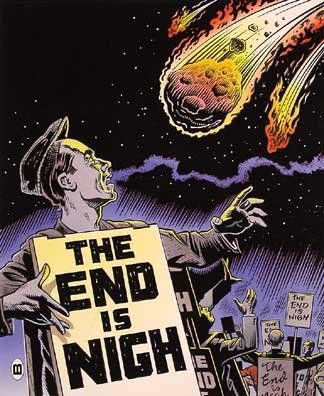
If we find just one more civilization like us (so the reasoning goes), then we're back in hot water. For then we're not unique in the Universe, and we are back to explaining why we've detected absolutely no one else, without the comforting possibility that we're the first to make it this far. That increases the chance that our disaster is yet-to-come, and there will be an Armageddon. We may yet see astrophysicists standing on street corners wearing sandwich boards that read "The End Is Nigh".

My opinion

I am religious. That is the space that I've reserved for my "wide-eyed acceptance". However, I'm content to know nothing of the "true nature" of God. If God is God, that would be a futile exercise of hubris. There are a lot of conflicting religions in the world, and not everyone can be right. Those that are right can't be right about everything, for some of what they teach conflicts with Nature. I am, therefore content to interpret the "books of revelation" as being figurative and the "book of nature" as being literal with respect to physical matters. There is only one book of nature, and we are all subject to natural law irrespective of our beliefs.

Forget the rest of the Universe for a moment, and let's narrow our search for intelligent life to just one place... the only place we know life of any kind to have arisen... the planet Earth.

Evidence indicates that Life on Earth arose some 3.7(ish) billion years ago. That's rather early in the existence of this planet. However, it took a billion years for a singular event to occur... a bacterium invaded a cell and rather than get digested, it took up residence. It became the fore-runner of mitochondria. All multi-cellular organisms are eukaryotes, descended from this union. And animals that we'd recognize as animals (jellyfish)...? They've only been around for about 570 million years. Homo sapiens have been around less than 200,000 years, or about 0.005% of the total. Humans lived without any durable civilization for all but the last 10,000 years or so. Nearly all of our technological advances have occurred within the last 150 years. Furthermore, evolution doesn't favor intelligence. There is no "evolutionary ladder".  Even if every condition is right for intelligent life, it won't arise if there doesn't exist the need for it and the mutation to take advantage of that need, at the same time[5]. Even on a planet as supremely hospitable as Earth, with myriad species for raw material, plenty of competition, and billions of years, technologically advanced creatures have only appeared once.

Let that sink in. Even if Life itself is common, simply getting to multi-celled organisms is hard. Getting those organized is harder still. And even when you have all the intelligence you need, technology doesn't necessarily follow. It took us a long time to get there. But when a breakthrough happens, it happens fast.

The Earth has a number of truly unique features:
  • Ours is a "Population I" star. Its components were gathered from a dust cloud that contained a rich amount of heavy elements such as uranium. These elements were formed in the explosions of supernovae from previous generations of stars. Because Sol is a Population I star, the planets that surround it (formed from that same dust cloud) also are rich in heavy elements. The presence of radioactive materials could have had a hand in promoting mutations without burning us up. Certainly, our body chemistry depends on elements that are heavier than iron[3]. Chemistry like ours could not have existed in the early Universe, and Earth contains enough precious metals to plate the planet to a depth of 4 meters.
  • Our planet has a molten core of iron, that enables it to generate a strong magnetic field, shielding us from cosmic rays. A little radiation is good for evolution, but a lot of it will yield a barren rock. Look at Venus, Mars, and the Moon... all in the habitable zone.
  • Ours is a double planet. Our abnormally large Moon causes tides that would have encouraged the evolution of amphibians and land-dwellers. Without tides it's less likely that animals would ever have left the seas. Our Moon was much closer in ancient pre-history, and the tides much stronger.  "Missing your bus" when the tide went out wasn't a trivial matter. Also, the Moon stabilizes Earth's rotation. Earth's axis wobbles, but not erratically as it might without the Moon.
  • We have a lot of water. This stuff is practically a miracle liquid. It dissolves most substances, exists in solid, liquid, and gaseous forms within a narrow range of temperatures (and at the same temperature!), and is necessary for organic chemistry.
So we're on a planet with stable rotation, at the right temperature, shielded from cosmic radiation, having just enough heavy elements of the right kind, and having liquid water seas with strong tides. I can count on one finger the number of planets we've found that fit that description[4]. You're standing on it.

The fact that we're not orbiting a first- or second-generation star is significant, in my opinion. Chemistry like ours could not have existed in the early universe, so I think it's -- not entirely, but somewhat -- misleading to offer up the age of the Universe as a variable. Properly, it would be the availability of Population I stars with rocky planets in the habitable zone.

In any event, with these factors in mind, I have no problem at all with the idea that we may be among the first sentient, technologically advanced lifeforms in the observable Universe. There may be others, for if the time is ripe here, it may be elsewhere; but it wouldn't surprise me that their radio waves haven't reached us yet. Our own have only had time to spread some 90 light-years.

And if we do find others? What then? Well, I wouldn't cringe with fear of the Anti-Life Equation (the Great Filter). No. If we're "among" the first, then so would they be. Somebody has to be in the first class. At the very least, when science confirms the possibility of a global conflict predicted by religion, it's probably a good idea to get our houses in order so our fears don't become self-fulfilling prophecies.

And speaking of prophesies... science nerds, this is one area where you owe the "religious nuts" a bit of respect. They have the cajones to admit they believe in the exceptionalism of Mankind and an impending battle at the End of Days on faith. If you're proclaiming that the sky is full of aliens that we can't detect because they've offed themselves in an inevitable conflict, you're doing the same thing.


[1] I link heavily to Wikipedia here. This is not a scientific treatise or term paper (I used a picture of Darkseid, for Pete's sake). The links are for your benefit, not mine. Wikipedia is generally clearly written, and if it isn't then there are folks (like me, occasionally) who go in and fix it. It's also well-referenced. Wikipedia is not the end stop in a quest for references, but it's can be the beginning of a discussion. If you need more than a cursory understanding of a subject, dig in to the references there until you're satisfied. Really, folks, if you're complaining about the use of Wikipedia, it's an extremely strong indication that you don't know how to use any reference, and shouldn't be on the Internet without adult supervision. 

[2] Presumably our Utopian future will be just like Star Trek, only without aliens in the Federation, or warp drive, or transporters, or particles-of-the-week, or subspace radio....

[3] Elements heavier than iron that are required by the human body include Cobalt, Copper, Nickel, Zinc, Selenium, Molybdenum, and Iodine. Arsenic is also required in trace amounts, but we don't know why. We do know, however, that completely removing arsenic from the diet of test animals caused them to become ill..

[4] I know what you're thinking... "What about Europa?" Keep in mind we're looking for technologically advanced civilizations, not algae or fish. Europa has more water than Earth, and we think it's kept liquid by friction from the tidal forces exerted by Jupiter and its other moons; but it's also bathed in severe amounts of ionizing radiation. For life as we know it to remain stable, it would have to live beneath that thick ice sheet, which means no fire, and therefore no metallurgy, and therefore no technology that we could recognize.

[5] It is distinctly possible that sentience is the result of sexual selection and is only incidentally a survival advantage. As sexual selection is arbitrary, even if all conditions are perfect and the opportunity and the mutation present themselves, it won't do any good unless somebody thinks a big brain is sexxxy.