Saturday, May 09, 2015

The Hague Declaration: Not Only No...

It's not often that Creative Commons posts something on Facebook to which I take exception, then I saw an infographic from The Hague Declaration:


It's called "Big Data Can Reshape The World and Save Lives". I'm linking rather than embedding the infographic because 1. it's bloody long, and 2. I don't agree with it, just as I don't agree with the Declaration itself. Now, that may seem odd coming from me, as I'm a big proponent of Creative Commons, Free Software, and produce free software and music myself. And it may seem incomprehensible that I could oppose something with such an awesome title and has such bodacious benefits. After all, it heals lepers, calms the sea, and raises the dead. Nevertheless, this Declaration is one of the most thoughtless bits of sloppy thinking I've seen since the Occupy Wall Street crowd published their "Silly Demands".

Let's start by taking a look at the Principles of the Hague Declaration:

1. INTELLECTUAL PROPERTY WAS NOT DESIGNED TO REGULATE THE FREE FLOW OF FACTS, DATA AND IDEAS, BUT HAS AS A KEY OBJECTIVE THE PROMOTION OF RESEARCH ACTIVITY

Oh, dear, they're in trouble already. This is factually incomplete. As explained in the U.S. Constitution, copyrights and patents exist "To promote the Progress of Science and useful Arts, by securing for limited Times to Authors and Inventors the exclusive Right to their respective Writings and Discoveries."

One aspect of science is research. But IP doesn't exist for that one aspect, nor for science alone. Rather, it is to promote science and the useful arts, aka engineering and manufacturing. Furthermore, the mechanism by which this is accomplished is, in fact, the regulation of the free flow of facts, data and ideas. In the case of patents, this regulation is intended to accomplish several things. Among them:
  1. to allow inventors to realize an uncontested profit for a limited time, so as to encourage invention.
  2. to prompt inventors to make speedy progress by limiting the time period in which this monopoly is available to them.
  3. to prompt inventors to give up the details of their inventions to the public through patent registration. In exchange for these details, the limited monopoly is granted.
  4. to take advantage of the work of others, in that the work of expired patents may be freely adapted and used by engineers, manufacturers, and other inventors. Once a patent expires the work belongs to the public. Therefore a patent is merely a delayed grant to the Public in its entirety, fully explained; in exchange for which the Public grants the inventor a time-limited opportunity to capitalize his invention.
The benefits of copyright are similar, and while copyright law is perverted and extended far past reasonable limits, the solution to that is not to throw out the good with the bad. Copyright law needs reform, but this document doesn't address it.

The Hague Declaration simply gets it wrong and the very first point. This doesn't bode well.

2. PEOPLE SHOULD HAVE THE FREEDOM TO ANALYSE AND PURSUE INTELLECTUAL CURIOSITY WITHOUT FEAR OF MONITORING OR REPERCUSSIONS

This, as we will see, is supremely ironic. Also, one-sided.

While the authors want freedom from interference from "any body", citing privacy concerns, with no regard to the privacy concerns of those who originated the data. In vernacular, they would like access to all of your stuff, and don't you dare ask what they're looking at.

The statement, "The use of facts, data and ideas must not prejudice the legitimate rights of individuals to privacy and a private life," is mere platitude, as the rest of the Declaration renders it meaningless, as we'll see.

3. LICENSES AND CONTRACT TERMS SHOULD NOT RESTRICT INDIVIDUALS FROM USING FACTS, DATA AND IDEAS

I'm calling BS on this one as well... ironically on the grounds of Natural Rights. And in this discussion, the word "speech" is a shorthand stand-in for any exchange of information.
  1. A right to free speech is not simply the freedom to speak. It is necessarily accompanied by a right to decide for yourself when and where you will speak, how your communication will be phrased, and to whom it will be directed. Unless you have every single one of these freedoms, you do not have free speech.
  2. Your freedom of assembly and speech require that you be allowed to decide for yourself the parties with whom you will associate. You have the right to keep your mouth shut unless you deem the conditions suitable for speech.
  3. You have the right to enter into collective agreements with like-minded individuals. If you can't agree as to contract terms, you don't enter into the contract. You walk away, and do without, or get what you need elsewhere.
  4. If you're not a party to a contract, it's none of your business.
I promote Free Software. This is routinely accompanied by contract terms that restrict individuals from using facts, data, and ideas in certain ways. These terms are there for the benefit of society in general, as they restrict the user from employing the software selfishly. As with any contract it is either freely accepted or rejected... if you don't like it, don't use it.

4. ETHICS AROUND THE USE OF CONTENT MINING TECHNIQUES WILL NEED TO CONTINUE TO EVOLVE IN RESPONSE TO CHANGING TECHNOLOGY

Ethics is far too fuzzy a term to be useful here. That said, the fuzzier the term, the fuzzier the rules need to be to be broadly applicable. You will find that "take only what others freely give to you" is applicable to any technology.

5. INNOVATION AND COMMERCIAL RESEARCH BASED ON THE USE OF FACTS, DATA, AND IDEAS SHOULD NOT BE RESTRICTED BY INTELLECTUAL PROPERTY LAW

This is in direct conflict with the purposes of Copyright and Patent law as authorized by the Constitution. ALL research is based on "facts and data", so these terms are totally meaningless here. However patents are ideas... and it should be immediately obvious to you that a patent is preceded by research and experimentation that is governed under the principle of "trade secret" until such time as a patent can be expressed and filed. As we've discussed, patents are granted exclusivity for a purpose, and for a limited time. So wait with patience, or find another line of work.

There are a number of waffle terms though this Declaration that render it meaningless or self-contradictory, such as "content which as been obtained legally". You might agree to every term of this Declaration, and this clause would nullify it all were it not nullified itself by other terms.

It's My House

This document is written for researchers and deals with the focused area of data mining. The take-home message of it is that the authors believe that anything that can be read (by humans) should be capable of being mined (by automation). I highlight this distinction between humans and automation because the distinction is necessary, as there is exactly no impediment whatsoever to the mining of data by humans of that information they can already read. Without the distinction the Declaration has zero impact.

I view a free society as one in which Libertarian principles prevail. So you may use what you given, but this does not grant you license to take by force. And there are legitimate privacy concerns among individuals and the providers of communications and social networking platforms. These privacy concerns are addressed by Terms of Service, Usage, and Privacy contracts intended to both protect the individual and improve the profitability and sustainability of the social platform. This is a perfectly reasonable application of both contracts and intellectual property, melded with the natural rights of speech and free association in a digital society. So if an individual or group of individuals wish to withhold data from you... tough. They're acting within their own bounds of free speech, including the freedom not to speak and to choose their audience. You are free to choose more accessible sources of information.

This may cause research journals that are not machine-readable to lose their authoritative standing. Wonderful, those journals deserve it. It doesn't take a law.  

It may mean that certain tools that are restrictive are preferentially discarded by those who publish research. Marvelous, the publishers should have given you what you needed. It doesn't take a law.  

It may mean that researchers stampede toward new, open journals that will take the place of calcified stalwarts of academia. Fine, it's time for a change. It doesn't take a law.

The Hague Declaration doesn't just throw out the baby with the bathwater. It has collateral effects that are not of any concern whatsoever to the authors. In effect The Hague Declaration demands a law saying that it's legal for Peeping Toms ("researchers") to take home movies through the windows of your house because your house has windows ("human readable"), and because interesting stuff ("undiscovered data") may be going on in there. Furthermore, it demands that the law declare that such Peeping-Tomery is explicitly excluded from other laws because they wants it. Furthermore, it demands that it is illegal for the landlord to install curtains ("DRM", etc.) to prevent such Peeping-Tomery. And oh, by the way, the Peeping Toms will totally respect your privacy.

Answer: Fuck off.

You're not entitled to what someone else has just because you want it or because it will be useful to you. If you don't like the game as it's played, start a new game. Will that solve the problem? Well, ask yourself how many people play Rounders now that we have Baseball.

Saturday, May 02, 2015

A Visit to Niceland (or, "What is Money?")

I titled this piece not because I intend to give you the same old explanation that doesn't make any sense, but because I want to explain it in (hopefully) a different way... one that gives you a better understanding of what money actually is in a way that hopefully shines a light on everything else you ever read about the economy.

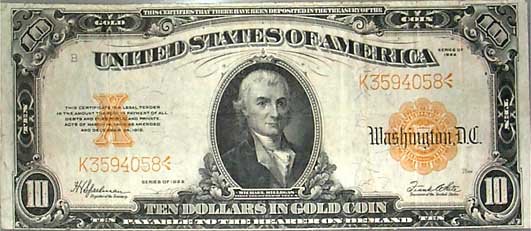
You've probably been taught, as I was, that money is valuable. This doesn't make a whole lot of sense because it's just pieces of paper or numbers in a computer. Perhaps you've been taught that it represents value, perhaps your share of the gold in Fort Knox. "Money doesn't grow on trees," went the adage, because it represented some amount of physical gold or silver. After all, the gold and silver certificates that were the precursors of our bills used to be printed with "Pay to the Bearer on Demand". But even when they were common, you really couldn't expect to walk out of the bank with gold in exchange for you certificate. Today that message is removed entirely.

Money used to be a convenient way of "carrying" gold
image via wikimedia commons

If you're really savvy you've been instructed that modern economics is "driven by debt". That in itself is pretty incomprehensible. Debt is debt, and it doesn't really make a lot of sense that debt should make money spring into existence, does it? Other people have explained this, but all of those explanations that I have seen (such as The American Dream film) are bigoted fear-mongering conspiracy theories applied to the American system. I'm going to explain how you arrive at a fiat monetary system through good intentions rather than Machiavellian machinations.

So what I'm going to do here is chuck the whole system aside for a bit and explore what the world looks like without money. What if capitalism had no capital?


No money, No money, No money....

In this imaginary society ("Niceland") people don't use money. Instead they just do what they choose to do. But of course, as you might expect, not everybody is very good at everything. You might want to call on your neighbors to help you out. Everybody in Niceland is... well... nice, so they haven't any problem at all helping their neighbors out.

You might immediately conclude that Niceland was a communist country, but no... Communists use money. They just don't call attention to it. Communists live by this principle: "From each according to his ability; to each according to his need." Mostly they like to keep things "fair" by demanding more from some people than from others, then spreading the money around more or less evenly. Mostly "less", since some people are going to get a lot more than they give. If that doesn't exactly sound fair, it's because Communists aren't really that nice. The illusion of altruism masks something much darker. You see, "ability" doesn't mean desire or effort, nor is it a self-assessment. Instead, they'll just take whatever it is they decide you owe, all the while informing you that it's "fair". And let's be honest... giving away someone else's stuff doesn't make you charitable. Nor can a victim of armed robbery be hailed as a philanthropist.

No, in Niceland we have no money, and we don't use force. Instead we just do favors for one another voluntarily and cheerfully. Of course, since we're all very nice in Niceland, we all hope to return the favors we receive someday.

In Niceland, we're very nice.
image via printablecolouringpages.co.uk
When you're dealing with a lot of nice people, it can get pretty complicated remembering who you want to return favors to. So we make things easy here by giving someone an IOU when they do us a favor. Sort of like, "IOU one favor". Sometimes we like to keep a little better track of it, so we'll write "small favor", "favor", "big favor", or "great big favor". Then, when someone needs something from us they can just present the IOU that we gave them, or give us one of their own. A lot of these IOUs don't exist before we receive a favor. We just write them down on a new slip of paper when we need them. But that's cool because we all accept each other's IOUs. We're that nice.

Seems legit.
When we started doing this in Niceland it was all well and good for a while, but then some of us started to feel bad because we really wanted to return favors to people, but some people didn't really need what we had to give. I might owe you a favor, but since I only make rubber widgets, you might never need what I produce. What you really need is something that Bob can give you. No problem there! I gave Bob some rubber widgets, and as a result I have one of Bob's IOUs here. I can give you that, and you can take it to Bob. I'll just give you the favor that Bob says he owes me.

Now some things become pretty clear about commerce in Niceland:
  1. Some  of us can't really return a favor in kind. And so we write IOUs that we are knowingly incapable of redeeming.
  2. The people who receive those IOUs know as well as we do that we're never going to redeem them. They plan to pass on the obligation. In fact...
  3. The best we can do is trade in other peoples' obligations. But really, those were given just like ours, by people who have no intention of ever repaying in kind.
  4. Everybody's too nice to publicly notice the fact that the IOUs don't really mean anything.

Let there be...

A "fiat" currency is one where money just springs into existence by decree. The IOU is a perfect example, because I can just write one, and it has value, backed only by my promise to repay the favor. The IOU incurs an obligation. It doesn't just act like money... it is money. Gambling "markers" are traded all the time. They're just IOUs. A marker is as good as cash until the casino calls it in... and only then are some of them revealed to be bad checks. A marker is also a good example of real-world currency that's not issued by a bank.

Far from being a money-free society, Niceland naturally[1] gravitated to capitalism, with a fiat currency called the IOU, backed by good intentions. It really and truly is "driven by debt", and it's a pretty good approximation of what we have in real life in the United States, with two significant exceptions.

The first significant exception is motivation. Nicelanders are driven by a desire to make good on their obligations, whereas Americans are driven by a desire to accumulate the obligations of others, represented by currency. They don't think of it that way, of course. Mostly, they don't think of it at all. They just know that money gets them "stuff", so... mo' money.

The other significant exception is the Bank. And not just any bank, but one particular banking system, the National Reserve Bank. It's the only entity that's legally allowed to issue "dollars", which is what we call our IOUs. It exists to solve the problem of "good intentions." You see, so long as we traded in existing IOUs that represented actual services promised, the value of each IOU was pretty solid. But some people realized that they could just write the IOU with no earnest intention of repaying, When that happens they just run around writing IOUs that are completely worthless.

Fiat money is essentially a promise. Belief = worth.
image via anoregonconservative.typepad.com
Money is whatever you exchange, even if it's promises.
image via secretsofvancouver.com

That happens in the real world, too. If people could just get whatever they want by making empty promises, they will. They won't bother to trade in currency obtained from others. Soon, IOUs are flying everywhere and they're worth nothing. It gets to a point where no amount of currency buys anything at all, and that's hyperinflation. So to prevent this, what's needed is some issuer of currency that can never go broke and can never renege. So except for some outlying examples like gambling markers (which are kept mostly honest because they'll be cashed in for currency), all of the currency in the United States is issued by the Federal Reserve Bank system. And the Federal Reserve Bank system is controlled by, and pays its profits to, the government of the United States. In theory, the People.

Note: I know that you might have been told that the "Federal Reserve Bank" is owned by shadowy foreign interests beholden to no one and that they hold the US Government in thrall. It is the central theme of the film "The American Dream". This is, to put it mildly, anti-Semitic, bigoted horseshit. It is the literal meaning of the conspiracy trope that "the Jews control everything" (the Rothschild family is Jewish)

First of all, there are twelve Federal Reserve Banks. By law, the Federal Reserve banks pay out a 6% dividend to their stockholders after expenses. Its stockholders (again by law) must consist of US commercial (not investment) banks. No Fed stock may be owned by any foreign interest or any private interest (look it up). All profits of the Federal Reserve above the statutory 6% dividend and operational reserves are paid to the Treasury of the United States of America. 

Hyperinflation. In 1923
Germany, currency was
cheaper than firewood.
Since we "pay" our currency back to "ourselves", the dollars are good so long as we never call them due. We say they're backed by "the full faith and credit" of the United States Government. In other words, by our belief alone. And "full faith and credit" means that the government will never default on a debt. If necessary it will... er... issue more debt. Sounds screwy, but yeah. It really works that way. Debt is the only legal tender.

And yes, I know that you've been taught that it's the other way around; that money is used to pay debt. But that depends on the fiction that money has actual value. In reality it always represents debt... a promise to repay. When you take out a loan the actual repayment is in the goods and labor that you give up to acquire the money used to repay the loan. That's where the value is. The dollars are just markers.

The danger is when politicians, having learned that money is simply a promise, promise everything to everybody... and not through their own efforts, but by the easy means of fiat. They make empty promises in which the debt is paid with more debt, with nothing of actual value having been produced. And that's contrary to the nature and purpose of the system, which is to be a stable and reliable keeper of promises.

When people lose confidence in this system, the money loses its value and People then look for a harder currency... in effect, "cashing in the markers". And that's when the whole thing collapses. It is we the People, through our government and our own self-discipline, that have the task of keeping our currency strong by limiting our debt to that which we intend to repay in kind. We should limit government spending not because we'll "run out of money". We won't. We should do it because otherwise the People will run to other money having lost their faith in ours. Then what we have will be worthless.


I'll come back to Niceland in a later post.


[1] I say "naturally" because it always happens. Always. Money changes hands in the People's Republic of China. In Star Trek (supposedly a money-free society), gold-pressed latinum is the de-facto currency (because it can't be created in a replicator). And where that's not available (as in Star Trek Voyager), the currency of choice was "replicator rations". Still, no one ever went hungry, did they? Truly communistic societies of greater than a handful of people are completely fictional.


Saturday, April 25, 2015

The Earth Moves Around The Sun. So What?

I often complain about "junk science", and in that context I've talked about expertise "within a domain". Here's where I do the same, but with a possibly surprising opinion.

This was seen on NPR.com:

1 In 4 Americans Thinks The Sun Goes
Around The Earth, Survey Says

So NPR reports that 1 in 4 Americans think the Sun goes around the Earth. So did Sherlock Holmes. A.C. Doyle had a point when he wrote that particular character trait. It is a simple fact that there are vast tracts of knowledge that are of no practical use to the general public, or even highly intelligent people whose specialties are not impacted by the knowledge.

As deplorable as we may believe this statistic to be, it's not an indictment of science education. The proper solar model IS taught in school. What the statistic does is indicate that these people don't bother to retain the knowledge. This doesn't surprise me, as for a great many people this bit of information is of no practical use whatsoever. Whereas I hold someone's feet to the fire when they claim expertise, for the vast remainder of the populace, this just isn't the case. Nor should it be.

Even something as solar-dependent as farming does not require an understanding of heliocentrism. Even the most highly respected and accomplished of astronomers STILL say "the sun rises in the East". That's true of the scientists. For most people, there's not a single benefit to understanding heliocentrism. If a practical need for the knowledge did arise, they could trust a specialist to inform them.

Even the most highly educated experts use paleolithic terms.

Keep in mind that the respondents to this survey are not claiming that a centuries-old disproven theory is true, as has been suggested to me. In fact, they're not "claiming" anything. Rather, they are responding to a multiple-choice question asked of them, and they got it wrong. That's pretty harmless.

Perhaps, it has also been suggested to me, a greater understanding would "affect the world". Would pollution be less of a problem if the Earth were fixed in space? Of course not. Poison is poison whether it's on a world that's moving or standing still. It is eminently possible for someone to be environmentally conscious while being wholly ignorant of astronomy. And so long as their actions are in accordance with conservation, their astronomical beliefs are irrelevant. 

It's a matter of domain. And listen up, because getting this wrong has dire practical consequences.

I'm a computer software designer, programmer, and consultant with a background in low-level electronic repair. I'm a generalist who makes his living as a problem-solver, and I've been doing this for over thirty years. I'd estimate that roughly 95% of the people I deal with daily know less about the machines than I do and fewer than half know the basics of how they work internally. 100% of them use computers daily. I could decry the lack of education among computer users, but that's unreasonable, and would be nothing more than elitist on my part. Would knowing how doped silicon and germanium gates are constructed make them better at their jobs or improve any aspect of their lives in any way whatsoever? Absolutely not. It's enough that SOMEONE knows how that's done, and that the users can trust them to manufacture proper tools; and that SOMEONE has the knowledge to create software that works to specification.

This is true of most things today. You drive cars and fly in planes without the knowledge to build them, or even maintain them beyond the barest minimum. Many of the people who trumpet our "advanced technology" couldn't build so much as a toaster from scratch. And there's no reason they should, except by personal choice.

Instead of making my users feel like schmucks, I recognize and accept that my expertise is unimportant information from their perspective. Their expertise is in using the tools I build to accomplish other tasks. Their lack of computer knowledge doesn't make them stupid in the least; all are highly educated professionals. They simply have no need for the knowledge. This is made possible by the fact that we live in a civilization that promulgates division of labor. Humanity didn't get very far when all the knowledge required to survive had to rest inside your own skull. Hell... you try making a flint knife. It might throw the light of reality on your claims of "advancement".

It's a mistake to jump to the conclusion that someone is stupid or poorly educated simply because they have not retained knowledge that is useless within their domain. Adopting that attitude simply leads to unsubstantiated stratification, dissent, discord... arguments. And it opens you up to being treated like a fool when you find yourself within the domain of those people you previously considered to be idiots.

This can come in handy to understand when someone from the "Geek Squad" or some "Genius Bar" treats you less respectfully than you deserve. It is because they don't fully understand the difference between intelligence and intellectual domain. The failing is theirs, not yours.


Thursday, April 16, 2015

It's Election Season. Out Come the Strawwomen.

Michael McCutcheon has written a piece over at mic.com called "9 Reasons Why America Should Never Have a Female President". Keeping to his well-trodden "X Reasons Why..." style of tongue-in-cheek, it's a pointedly sarcastic bit that acts as an unpaid endorsement for Hillary Clinton. Her thoughtful visage dominates the page:


The real purpose of the piece, of course, is to pass on the message that if you don't support Hillary Clinton, then you're a rabid, knuckle-dragging, atavistic sexist.

The problem with it is that it's simply... well, "useless" comes to mind. Because there is no broad audience that agrees with the "arguments" McCutcheon is lampooning. But remember, his audience isn't conservatives; it's liberal Democrats. He's telling liberals what they should think conservatives think, so they can go out and hate conservatives for thinking the things that McCutcheon told them about. I know it's a lot to wrap your head around. There's a reason they're known as "the loony Left".

Anyway, here's what he wants you to think conservatives think:
  1. All female politicians care about is birth control, birth control and more birth control.
  2. Women fail miserably when they run Fortune 1000 companies.
  3. Women governors are some of the most hated in the nation.
  4. No one experiencing menopause should ever be making decisions.
  5. Women just don't have what it takes to get things done.
  6. They have exactly the wrong kinds of traits for a leader.
  7. Study after study reinforces how drastically ineffective women really are.
  8. Women in Congress can't get money for their districts, pass a bill or really get anything done.
  9. And most of all, America doesn't want more women in office.
As far back as the 1980s you'd have been hard pressed to find an American conservative who wasn't a fan of Margaret Thatcher, or who wouldn't have voted for her if they were English, or she an American.  Carly Fiorina (herself a potential Republican candidate for president in the present) is one of those company CEOs talked about in point 2. Of course, HP was a bit better than a "Fortune 1000" company... or "Fortune 500"... or even "Fortune 100". They were ranked #9 during her tenure. And Fiorina herself was ranked the tenth most powerful woman in the world.

The women listed include my own governor, Nikki Haley, Republican. Of course, Susana Martinez of New Mexico also has an "R" after her name. It wasn't the liberal Democrats who voted either of them into office. So, two thirds of the female governors listed were Republicans. If we were inclined to look backwards slightly we'd find the former governor of Alaska, Sarah Palin, on that list of female Republican governors. That's the same Sarah Palin that was on the Republican ticket as V.P., who was roundly ridiculed by liberals for the very femininity that that conservatives are supposed to hate. Part of their ridicule hypocritically focused on her looks. Part of their ridicule focused on her supposed stupidity in foreign affairs. History has, however, proven her foresight to be somewhat more reliable that that of our "sooooper-genius" POTUS, Wile E. Coyote Barack Obama.

Conservatives couldn't give a rat's ass about a candidate's sex. Whether she's a woman isn't the question. The question is whether she's the right person. The plain fact of the matter is that conservatives aren't the sexists that liberals would pretend them to be, nor does liberalism erase sexism. Sexism is completely and totally part of the Democratic playbook when it targets anybody but a liberal Democrat. This piece of McCutcheon's is an example. Democrats, on the other hand, have no problem voting for someone simply because of their sex[*][**]. 

This piece argues with the invisible man. Since the people he's targeting know their own minds, such a tactic has zero potential to change anyone's opinion. And improper use of the "sex card" is so bloody obvious that the author makes himself look very, very stupid. 

I'll leave you with this parody of Rick Perry in the "Brokeback Mountain Jacket", because McCutcheon somehow managed to miss "obsessed with fashion" in his strawman list, and as we all know, this sort of demeaning "attack" is only leveled at liberal women:


[*] I can't help but point out that the Gallup poll I linked to does not list "would be first female president" as the top response to the question of what would be the most positive thing about a Hillary Clinton presidency. No, the top answer was "Nothing" (at 27%) followed by "No opinion" (at 22%). "First female" was third, at 18%.

[**] Of course, the ghost of Geraldine Ferraro spins in her grave at the chorus of "It's about time!" praises of Hillary Clinton. But that was 30 years ago... what do these kids know?


Wednesday, April 15, 2015

Yes, Marxists Really Are Pathological Liars

Found online:
Often I find libertarians, after describing some basic principles (non coercion etc.), make the jump to property rights and capitalism being the bestest thing ever, without fully explaining it.* 
*To be sure, libertarians do have plenty of fleshed out arguments for capitalism’s efficacy as a system; what I am arguing is that it does not follow from their discussion of man and his nature.
Of course it does. Every man is entitled to the fruits of his labor. But "labor" doesn't just mean sweat. It is effort in all of its forms. What it is illustrated when a lever or pulley, or Archimedes screw multiplies a man's effort is that the mental effort of inventing and employing those tools greatly multiplies a man's productivity, and thus increases the fruits of his labor. This is obvious in these examples: the more of one's brain that is employed in an enterprise, the greater the return.

"Give me a lever and a place to stand, and I will move the whole Earth."
-- Archimedes

This applies to principles, procedures, and algorithms every bit as much as it applies to physical tools. Thus we see that an entrepreneur has a higher income than a day laborer. This is because he's engaged in more productive effort. There's nothing inherently unfair about this. The laborer can do the same through his own efforts, and many have.

And I know you're wondering how I could possibly say that an entrepreneur is engaged in "more productive effort" than the guy breaking his back.

I say it because it's true.

Let's put it this way: The worker is working to feed himself and his family. He does so by engaging in activities that do just that, and barely. On the other hand, the entrepreneur is engaging in activities that will employ hundreds or thousands of people and feed all of them and their families. That's not figurative speech. His activities will result in sales, opportunities, markets, and income that will directly pay them all. And not just them... he will also pay their unemployment insurance, and the employer portion of their Social Security contributions, and provide whatever other incentives he finds necessary to retain people who can together meet those opportunities, as well as typically set up philanthropies and charities. Without him, most of the people in his employ would simply find other similar low-level jobs. Only a very few might start businesses of their own.

You ask someone who isn't employing thousands, and they're likely to say that the CEO is just some lucky fat bastard raking in the cash. That's only because they're pitifully ignorant. They're also demonstrably incapable of the same feat.

The same on-line source repeats Marx's tired assertion that the capitalism and the resultant division of labor separates a person from the products of his labor. This simply and conveniently ignores the fact that no Communist government has ever eliminated currency, the division of labor, work schedules, oppressive work conditions, bosses and overseers, an over-privileged elite class, or ANY of the conditions for which Communism was originally conceived to alleviate. In terms of achieving its goals, Marxism is the most brutal failure in history, bar none.

On the other hand, capitalism is the "bestest thing ever" because it is the one system that allows a person to focus on his talents and strengths, converting that which he has in abundance into that which he does not have and can't readily produce for himself. And that is possible through ownership. I am compensated for that which I produce and am able to save that compensation as my possession. In this way I can make trades that aren't practical in barter alone and can leverage many small "sales" into one large purchase, or do myriad other things. There is absolutely nothing wrong with the system that enables this.


The Free Market is Win-Win

Furthermore, capitalism allows this exchange of talents without coercion. Keeping the above in mind, remember that a free market is this is the activity of many individual transactions, each of which is a freely accepted "win-win" proposition. In a free market nobody engages in a transaction unless they want to. I can't make you buy my products, but I can adjust my prices or quality until you decide you'd rather own what I'm selling than keep the money. I make a sale of widgets because you need widgets more than you need the money, and it's vice versa for me.

And if I screw my customers on price or quality, I don't need the government to shut me down... my customers will do that through loss of sales by boycott and bad publicity. They'll go elsewhere and enrich my competition. Some will see my failure as their opportunity, and they'll go into competition with me. It is that competition which defines a free market. The moment you have a monopoly, you have a de facto government.


Necessity Isn't Force

We've all heard the Leftist arguments that because people have certain "needs" that should be free for all without labor or expense. This starts with basic abstract Freedoms... speech, defense, personal space, etc., all non-materialistic and easily free. The Left then extends it to those things that are material... water, food, air... and then on to things that are unquestionably desires... cell phones, cable TV, spending cash. And they should all be free.

Not only is it simplistic, it's a deliberate lie.

Ignore the Blob-like expansion for a moment and keep it to basics... something that seems most reasonable. Let's take food for an example. And let's imagine that you're living an agrarian vegan carbon-neutral macrobiotic lifestyle where lions and lambs comb each others' lustrous coats in perpetual sunshine and lurrrrve. And it's yours, all yours!

There's no one to give you anything. You have to till the soil, tend and water the plants, defend them against blight and pestilence, pick the fruits, prepare and preserve them for the winter months. Despite the fact that you have a right to Life, it is still up to you alone to secure that right. All that free food isn't free, not at all. Not even when there are no owners. Not by any measure. This doesn't change when someone moves in next to you. No one is obligated to slave for you simply because you don't want to be responsible for yourself. And yet that's the position of the Progressive Left.

The Library Company of Philadelphia
was started by Ben Franklin and his
friends because they each wanted a
better library than any of them could
afford individually. It's still in
operation today, free and open to the
public. That's how Libertarians
solve a problem.
The plain fact is that even if food were lying around for the taking, it's still up to you to get off your ass and get it. There ain't no such thing as a free lunch. That said, there are people who will, out of the goodness of their hearts, pay for your lunch. It's called "charity", from the Latin caritas, meaning "love". The thing about charity is that it is by definition a gift of love. Such a gift can only be given freely. When taken by force, such as taxation, it's not charity: it's theft. That's something to remember on a day like today, April 15th. Socialists would like to pretend that society would fall part if it were not for taxation. But those things that taxes pay for would still be paid for. If there is a need, then people will always find a way to fund that need. Sites like GoFundMe, KickStarter, Patreon, and IndieGogo should be all the proof you need of that. If Libertarians want a library, they'll just contribute and build one... and how do we know? Because that's what they've always done. Crowdsourcing isn't new... not by a longshot.

If that's not enough, you're left to explain Shriner hospitals, which operate without charging their patients; and RiteCare centers for language disabilities, which provide their services to those children who need them without requiring them to pay a dime; and Ronald McDonald houses; and myriad other charities. These are done voluntarily, in addition to taxes. You cannot seriously believe that if people had more to give that they would give less. And you cannot seriously believe that enlightened self-interest is at odds with charity unless you know little of either. I've discussed charity before... if you want a society in which there are good people, there is only one way to guarantee it: be that person.

The benefits of capitalism are those which directly result from the libertarian principles of self-ownership and non-coercion. It is human nature to be generous so long as the means have not been stripped from them.

Overwhelmingly, the richest people... those mean old money-grubbing capitalists... have always been the biggest philanthropists. What's better than a person who gives to charity? A person who creates a job. A philanthropist is both. One of the things that a Libertarian wants as much as the next person is "a better world". Of course, to a Libertarian, this means that people are voluntarily charitable and don't have to be robbed; where they're nice because they're educated in civility, rather than forced into compliance. Those who benefit from institutional robbery have fewer barriers against the more personal sort. Furthermore, private charity is more effective than the public dole because it doesn't result in disincentives to achievement. This requires that people not only look after themselves, but look to better themselves and in so doing employ others.

The title of the piece to which I linked in my first paragraph is "Yes, Libertarians Really Are Lazy Marxists". This is hilarious, as it comes straight from the ideology espoused by the laziest ideologues ever to walk the face of this planet; and is directed at those who they would have as slaves. 

Yes, Marxists really are pathological liars.

“How do you tell a communist? Well, it’s someone who reads Marx and Lenin. And how do you tell an anti-Communist? It’s someone who understands Marx and Lenin.” -Ronald Reagan


UPDATE:

It has been pointed out to me that "the rich only give to charities because they're tax deductible. So it's the government that's really the public paying for those charities."

Sigh.

No. That's not what "tax deductible" means. Let's simplify it and do some math. For this example we're going to assume that there's a millionaire making a tax-deductible contribution of a million dollars, and he's taxed at a rate of 30%. So making the contribution saves him the taxes on the million:

$1,000,000 - (1,000,000 * .3) = $1,000,000 - $300,000 = $700,000

In other words, if the donor had simply kept the money and paid the taxes, he'd still be seven hundred thousand dollars richer than if he'd made the donation. If the money were not tax deductible at all, then he could simply donate $700 grand and feel no difference. In fact, he's already demonstrated the willingness to do so, and more. He'd give a million if he had it. Tax-deductible contributions are not, not, NOT an example of greed. They are an example of largesse.

Furthermore, in order to be tax-deductible, the amount has to go to an organization that is determined to have official status as a charitable organization. The People of the United States have agreed in advance that the recipient is worthy of the contribution. After-the-fact is a piss-poor time to start bitching about contributions actually made to them.

Furthermore, the money comes entirely from the millionaire. These are not government funds that have been handed back. These are funds that the People of the United States, through their government, have determined not to be taxable. In other words... it's not their money... by law. Again, after-the-fact is a piss-poor time to claim generosity for something that you agreed up-front wasn't yours to give.


Monday, April 13, 2015

It's Really Not That Hard to Understand


Here we have something that's making the rounds... CNN's Dana Bash questioning Senator Rand Paul on the subject of same-sex marriage. Now, he does accurately state his position... however, one thing this interview and the commentary about it has shown is the lengths to which people are willing to mis-interpret it. Here's one. Here's another.

It is certainly the case that people hear what they want to hear, and let's acknowledge that it's a little difficult to get a point across in responses that are edited by those who are asking the loaded questions. Since Bash is asking him "as a libertarian" I, as a libertarian, am going to take an unsolicited stab at the issue. For many of you it's tl;dr. If you can't at least give time to the issue, you're one of the folks we can conveniently label "the Problem".

Bash asks, “Why do you believe – just as a core principle as a libertarian – that people should be left alone, but not when it comes to their right to marry someone they love?”

This is a loaded question, and inaccurate. All people have the right to be left alone. That is, in fact, what Paul's trying to communicate here. But "leaving you alone" does not necessitate anyone's agreement or endorsement of whatever it is you're doing, marriage or otherwise. In 1906, Evelyn Beatrice Hall wrote a biography called "The Friends of Voltaire", in which she offers this as an illustration of his beliefs,
"I do not agree with what you have to say, but I'll defend to the death your right to say it."
Since so few people seem to be able to comprehend the English of a mere hundred years past, let's paraphrase that:
"I may not agree with who you want to marry, but I'll defend your right to marry who you want."
That's the libertarian position. Defending someone's rights despite your own disagreement is called "tolerance". Insisting that someone must agree with you heart and soul is not; and there's no small irony in demanding acceptance from those you repay with intolerance of your own.

What isn't appreciated in punditry is the fact that Paul can't deliver tolerance without being elected; and his position (as you can see) isn't popular with either party, though it does resonate with Americans who don't just think whatever they're told.

"He's on our side? Ignore it and attack anyway."
In politics, people don't matter, only Party.

So why is this a state issue?

Because it IS. You may have forgotten as so many do that the first clause of the First Amendment of the U.S. Constitution not only asserts that the government cannot establish a religion (this is the only part that the Left ever reads); and it not only asserts that the government cannot prohibit the free exercise thereof (this is the only part that the Right ever reads): it also states that Congress may make "NO LAW" regarding either. "No law" isn't really open to "interpretation"... merely misinterpretive bullying. It literally means "no law".

The Ninth and Tenth Amendments assert that we have rights that are not enumerated in the Constitution; and that any power not delegated to the United States by the Constitution are reserved to the States, and to the People.

Now, to the extent that marriage is a religious rite... and you have to be both barking mad and historically illiterate to assert that it isn't... it has no place in Federal legislation. Such laws are, in fact, prohibited by the First Amendment, although the remedial readers in Congress and even some judges haven't comprehended the phrase.

It is, in short, a State issue. Senator Paul is just stating the truth, and if you wanted to make it different, then you'd have to carve out some new Amendment.

The fact that we've had Democrats and Republicans offering and passing laws left and right about religion for as long as we've had Democrats and Republicans is beside the point. Just because they've pushed idiocy for a hundred years doesn't mean you have an obligation to continue the trend. And just because they pass a law doesn't make it final... not until it's been tested in Court.

So what does it really mean to be "a State matter"? Well, in times gone by it would mean that the States could pass laws individually, and that you'd wind up with a big mish-mash. They still try that. It doesn't work. The Fourteenth Amendment provides that, "No State shall make or enforce any law which shall abridge the privileges or immunities of citizens of the United States," and as a result those rights that are asserted in the Constitution are binding everywhere. And sure enough, the Supreme Court knocks down a shit-tonne of laws for just this reason. The practical result is that "no law" at the Federal level means that these rights are retained by the People. That is, you have a right that cannot be abridged.

We don't need more laws. We just need to follow the Constitution into that dark place in your psyche you don't want to go, where dragons roam free... and so does everyone else.


What about that wording?

To the extent that marriage a social contract it might be subject to legislation... but the fact is that the word "marriage" has been so intertwined with religious sacrament for so many thousands of years that it makes more sense for the Government to keep their stupid ham fists out of it entirely. This is, after all, the same government that would look down on a "moment of silence" in school lest it be used for (*gasp!*) voluntary prayer. "Marriage" is far more intertwined with religion than a moment of silence. And the Left, who have no problem at all passing laws prohibiting free exercise don't know how to react when the free exercise that's being prohibited is their own.

Instead, they viciously bite when Libertarians offer a supremely rational solution.

The solution is not to prohibit it, because that's discriminatory. And it's not to define it, either, because that's inherently exclusionary. The solution is to do exactly what the Constitution says to do and MAKE NO LAW. Then people can live with whoever they want to live; they can enter contracts with whoever they want; they can assign whoever they please to be their "next of kin" for whatever reason they'd like; and they can call it whatever they want to call it, whether it was announced in a church or not. Remove marriage from the law for everybody, and leave the contract for everybody.

So how does this compare with what Rand Paul has said?
In April 2013, in an interview with the National Review, he said, "I'm an old-fashioned traditionalist. I believe in the historic and religious definition of marriage," and "That being said, I'm not for eliminating contracts between adults. I think there are ways to make the tax code more neutral, so it doesn't mention marriage. Then we don't have to redefine what marriage is; we just don't have marriage in the tax code." -via Wikipedia
Yup. I'd get married in a church m'self; but y'all do what you want.

And for those among us who have long wondered at the inherent unfairness of the tax code when it comes to single individuals, this makes even more sense. A revised tax code would treat people as individuals, with their burden measured by their dependents rather than some embattled legal status.


Me, personally....

I don't care. Really. I don't give an ounce of concern over whether you're married, or who you're married to, or what it's called. I give even less thought to what people call my marriage, or whether they call it anything or nothing. If you tell me you're married to a water buffalo, I won't ask you what sex it is. I might think you're a loon, but I probably think that already for a lot of other reasons. If you're a man telling me you're married to a man I will receive the news with the same degree of casual "so what" that I have always seen in the eyes of pretty much everyone when I mention that I have a wife.

I do care about the fact that people are excluded from certain situations that they'd otherwise be allowed were it not for arbitrary laws that should not exist. It's not just taxes. That's why the contract should remain. If I want to empower someone to make decisions for me, for whatever reason I want (and I don't even have to state those reasons), I can already do that with a Power of Attorney and a Living Will and a half-dozen other documents. But it's expensive and inconvenient and requires constant explanation. There's a sense of "vere are your papers, Juden?" But a marriage license conveniently wraps all of those into one document that's pretty universally recognized. Even today, intertwined as it is with sacrament, "marriage" is afforded to atheists and every religion. In the sight of God you need no one but each other to marry you. but legally, you're married when you sign the document, not when you say your vows. The legal aspect does nothing to add or take away from those vows, no matter what they were called.

In fact, the term "marriage license" implies that the government is granting you permission to get married; something that should be offensive to Christians on grounds of piety in that no government has that authority. It is contrary to our natural rights.

If the union described by that piece of paper were suddenly to be called a "civil union" in the courts while I continue to call it "marriage" everywhere else, then I can see no possible way in which it would affect the reality of my marriage.

But then, those who argue at cross-purposes aren't terribly concerned with reality.


Sunday, April 12, 2015

Reflections on First Orbit

April 12th, 1961 - Yuri Gagarin became the first human in space. This film re-lives that feat in real time using stock footage and footage shot from the International Space Station.


My thoughts on this anniversary may seem odd, seeing as how for the last 54 years humanity has been a spacefaring race largely through the efforts of huge government investments and nationalistic chest-thumping.

But in that time, access to space has been restricted by the various governments on Earth, progress has been retarded by those same governments once they had their TV moments, political sound bites and news coverage; and as a result we remain tied to this planet save for a few pitiful robots and a handful of ankle-waders in atmosphere-scraping orbit. Contrast this with air travel, which has been mostly driven by private and economic factors.
  • The Wright Brothers made their first successful flight in 1903. 
  • The first scheduled air service was in 1914. 
  • In 1927 Charles Lindbergh made the first non-stop flight from New York to Paris. 
  • Jet engines appeared in 1942, in World War II
  • The first supersonic passenger aircraft (the Russian Tupolev 144) was flown in 1968. 
Humanity went from "Man can't fly" to supersonic commercial flight in a mere 65 years, and for the past 50 years commercial flight has been so ubiquitous that we can now earn "air miles" at the grocery store.

In 1954, this is where we thought we might be in the year 2000, and it was a reasonable expectation based on what our parents experienced in their lifetimes:


Ignore the cheesy special effects. It was the quality of their vision, not their models, that concerns us. Of course, our parents were far more daring than we have become. We're not just a nation, but a world populated by the delusional, sharing their delusions, and pretending they like it. We build cages so we can sit in them and pretend we are "free". We are superlative at faking those things that we will never attempt in real life, and patting ourselves on the back about having achieved "realism". It is in equal measure saddening and sickening.

Only within the past few years have our governments experimented... just a little... with allowing visionaries like Elon Musk and Burt Rutan do what they do; and to a huge extent this has been because our governments have proven themselves unequal to the task of sustained national interest, much less technology. Entrepreneurs, on the other hand, risk absolutely nothing except that which belongs to them and their willing investors. And they do so in full knowledge of the fact that the vast bulk of monetary returns are yet to be discovered.

Without committees, the entrepreneurial mind explores boundaries outside the confines of convention and national interest. This is important, because if anything at all is true, it is this: The Universe is not owned by the United States, or by Russia, or by China, or the European Union. It is not someone's lawn that we need to be told to stay off of. It belongs to none, and should be accessible to all. It is well past time for governments to back down and quit hogging all the Space.


P.S. On the anniversary of this great achievement it's not lost on me that these thoughts seem somewhat dark and negative. My point is this: the celebration of a past event is meaningless if we cannot use it as inspiration to do so much more than we have done, and to be so much more than we have been. Every advance at every point in the human drama has come about as a result of dissatisfaction. No one has ever done anything new as a result of being "ok" with the status quo. I am not ok with the status quo. We need to step up and do better. Those who are not of that mindset should simply shut up, live their risk-free "lives" and let the pioneers be pioneers. Get out of the way.